Showing posts with label first flush. Show all posts

Thursday, December 3, 2015

Original bottle of Chanel No. 5 }  
"Oh, it's so fragrant."

The aroma coming off the pot of freshly steeped First-flush Darjeeling provided by Phoenix Tea is, well, breathtaking. Floral, fruity, multilayered—the scent coming from the carafe is worth the price of admission.

According to The Fifth Sense website, the psychology of smell is worth exploring, because this sense triggers the brain's limbic system, which processes "mood, memory, behavior, and emotion." An extended quote:
{ Cherry Blossoms,  Japan }
Smell and Memory 
The sense of smell is closely linked with memory, probably more so than any of our other senses. Those with full olfactory function may be able to think of smells that evoke particular memories; the scent of an orchard in blossom conjuring up recollections of a childhood picnic, for example. This can often happen spontaneously, with a smell acting as a trigger in recalling a long-forgotten event or experience. Marcel Proust, in his ‘Remembrance of all Things Past’, wrote that a bite of a madeleine vividly recalled childhood memories of his aunt giving him the very same cake before going to mass on a Sunday. 
 
Smell and Emotion 
In addition to being the sense most closely linked to memory, smell is also highly emotive. The perfume industry is built around this connection, with perfumers developing fragrances that seek to convey a vast array of emotions and feelings; from desire to power, vitality to relaxation.
Parfumiers get it. Purveyors of fine teas get it, too. One may observe that our attraction to tea reflects this connection, as well. Drinking a cup of tea can bring about a state of hygge, the Dutch term for a sense of warm, comfy well-being—perhaps partially because of the presence of subtle relaxants (L-theanine, theobromine, theophylline), and most certainly the result of aromas that stimulate that part of the brain that influences memories and behaviors.

{ L'amour des Trois Oranges, Sergei Prokofiev }
Simply put: If you smell something that strongly evokes relaxing moments in your life, it may lead to a resurgence of relaxed behaviors and and habits of mind that will temporarily override or influence the present mood of tension, or striving, or frustration. It works on Thanksgiving, of course: the smells of turkey, and pumpkin pie, cranberry with oranges, and green Jell-O with weird salad things floating in it—all these fire up the neurons, with thick myelin sheaths leading the mind down paths not accessed since the last time you smelled these particular aromas. Habits quickly reassert themselves, and the smells of hearth and home become part of the structure, the mechanism by which the comfiness of home invades your personality so quickly and draws you into its embrace.

Today I drink a cup of tea with my students, sharing the pleasure of something new. The first steeping is, alas, slightly oversteeped, leading to a slightly bitter experience. Now, Darjeeling teas are like a particularly high-maintenance friend: If treated correctly, the friend is nothing but pleasure and delight; but if not given the proper care, bitterness and insipidity result.

Nevertheless, the aroma coming from the leaded-crystal carafe I use evokes a thousand happy cups of Darjeeling past, bringing with it a sense of balance and well-being that I associate with a relaxing cup—without having had anything to drink yet. Clearly, I'm highly suggestible, but nevertheless the observations above hold true: I feel like I've had a great cup of something delicious, happy, exciting, relaxing, delightful, and not a drop has passed my lips. Sharp and bright, lush and complex, a walk down a path with hidden gardens over a high wall. What is it I'm smelling? How can it be so evocative?

All that from a cup of leaf juice. Astonishing, isn't it?

{ Santa's zeppelin and angels have something to do with tea, I promise. }  

For Phoenix Tea's offerings, please go to their website. The proprietors know what they're doing, and they are happy to provide guidance if you need help making purchasing decisions. Only a few weeks are left before Christmas, so please consider giving a gift that can evoke memory and delight. Your loved ones will thank you, and hopefully during next year they'll remember with fondness the warmth of your love and friendship, as they sip your gift of tea.


Monday, July 15, 2013

I'm in Heaven: Darjeeling Tea Boutique, Longview 1st Flush 2013


Heaven
I'm in Heaven
And my heart beats
So that I can hardly speak
And I seem to find
The happiness I seek
When we're out together
Dancing cheek to cheek

When was the last time you were in the forest, walking along a pathway you've not trodden in, oh, just years, and the delight of seeing that particular curve in the path, or coming upon that expected clearing filled with bluebells makes you wonder how you could ever have waited so long to come back? Well, I just stumbled upon a panorama I've woefully been missing without knowing it.

My friends at Darjeeling Tea Boutique sent me a package today, and I just happened to have enough time in my schedule to open it up and make a cup. As my irregular readers know, I was in business making tea reviews with a friendly regularity for a bit over a year, and then I stumbled when I found every cup I had to drink required an accompanying essay. With a clever twist, or an amusing anecdote, or something so it wasn't just some guy saying, "Oh, well, this tea from x is plummy, with notes of pretension, and an underlying insouciance I find vaguely similar to motorboats and Chopin nocturnes, if you know what I mean, and I think you do." 

So feeling refreshed from a long hiatus, I can say, I am delighted that I have a decent Darjeeling in my clutches again. It's been a long time-- so long, it's a bit embarrassing, to tell the truth.  And by decent, I mean this particular cup is so fragrant, so vibrant, I wonder how I've been living on such gruel for so long.

Using tea terms, this is SFTGFOPI Clonal AV2, First Flush 2013, Longview Tea Estate. Or "Longview Queen," for short. 

Longview Estate, in Darjeeling, India, is at a lower elevation than many other tea estates, though some parts of the estate climb pretty high, allowing for that prized "highgrown tea" appellation. I can't tell you at what altitude this Longview Queen tea is grown, but it seems the tea has gotten enough sun and at such an elevation that this presents like a quite nice Darj., with the brightness and complexity you are looking for.

In contradistinction to many tea connoisseurs (and I'm merely an appreciator, so pardon my clumsy attempt to speak of things above my station), I don't hold much to making tea The English Way when it comes to a good Darjeeling. I go with my own modified gongfu method, which is Chinese for "Careful preparation: lots of leaf, short steep times, as many steepings as you can get." I find that even non-Chinese teas do well with this method.

{ I wish I had a dog's nose }
I'm on my third steeping, using my gaiwan set, which is a Chinese lidded cup. When you drink a cup of tea, first start by smelling the leaves when they're dry. Just open up the tin or container and take a good whiff. Pay attention to what you are smelling. Remember, your mouth only has five different tastes it can identify, but the nose can identify tens of thousands of nuances. Sadly, we're from a species that only has a very limited sense of smell, but we must do the best with what we have. Have a look at the leaves. Are they whole? Are they curly, tightly balled, long, short, broken, whole, no stem, lots of stem?

My second step is to get my lidded up hot with boiling water, pour off the water, and pour in a large amount of leaf-- perhaps two to three tablespoons' worth. I cover the cup with the lid, and I shake the leaves gently-- I don't want to bruise the gin, as it were. Open the lid lightly, and allow the aroma of the leaves, which are now beginning to wake up after a long sleep, to catch you. Is it different from what you smelled a few moment before, when the tea was dry and cool? Does it smell like flowers, or like spices, or like fruit, or like something else you can't quite put your finger on? Have a quick look. Are the tea leaves opening up a bit? Ideally, they will end up looking like, well, leaves fresh off a tree, not like powder or dust.

After this, I pour the hot water over the leaves, from as great a height as I can without splashing everywhere, especially on myself. Hot temperature plus pressure equals flavor and aroma. Quickly cover the tea with the lid and wait for less time than you'd think-- 30 seconds or so, not much more. 

{ This dog looks like
the Dowager Countess Violet
from Downton Abbey, no? }
NOTE FOR DARJEELING NEWBIES: Don't let your tea oversteep. Darjeeling is the Dowager Countess of tea. It's temperamental and likely to give you a biting, sharp reply if you don't treat her with the deference she deserves. Unlike a typical Twining's or whatever you may be used to, you can't just pop the tea in the water and let it sit for 5 minutes or so, or whenever you feel like pulling out the teabag. No, no, no, and again I say, No. Just-under-boiling water and short steeps. Say it again: "short steeps." If you let it go long, you'll walk away thinking, "I guess I don't like Darjeeling tea," when you probably just did it wrong. A good way would be to steep perhaps 2.30 or 3.00 minutes max. But if you do this in the Chinese gongfu method, with lots of leaf and short steeps, we're talking 20-second steepings at maximum for the first couple times. Darjeelings don't stand up to multiple steepings as well as oolongs or puerhs do, but you should get a good three or four steepings out of them, maybe even up to six if you have something good going.

Again, listen to the tea. Are its leaves starting to "wake up" and unfurl? What color are they now? This Darjeeling Tea Boutique tea, SFTGFGOP1 Clonal AV2 First Flush, Longview Estate tea is a multi-hued leaf with visual variations between forest green to a ruddy rust brown, with a predominantly reddish hue. Plenty of leaf, quite a few broken leaves, a few that are whole from stem to stern. And fragrant! If someone could turn this into a perfume and give it to my wife, well, I'd get even less tea writing done than I do.

{ Gongfu does not mean karate.
It means making tea the smart way. }
With gongfu, slowly increase the number of seconds you steep the tea on each pour. Start with 30, move up to 40 or 45, and start to judge how much you will need to increase to get more out of the leaf from that point on. You can steep up to several minutes toward the end, trying to get the last bit of flavor and aroma from these wonderful leaves. You have to experiment, play around with the leaves yourself, to see what they will do for you. Pay attention to the aroma by swirling the tea in your mouth and using your nose over the cup. Notice how the tea's chi is affecting you-- chi being the mystical Chinese concept of energy, or power; but from my worldview, it's probably the felicitous combination of caffeine with a number of relaxants, heat, and the time it takes to slow down and enjoy something.

Over time, you'll forget what the tea tastes like. I did. Even though I've had thousands of cups of Darjeeling, it's been a dry spell for far too long, and now I'm reveling in the unexpected-but-familiar experience that a good Darjeeling will allow you.

One of these days, I shall travel to Darjeeling to experience these teas at the estates themselves. Until then, I'll settle for breathing a bit of Darjeeling right here in Illinois.

Thank you, Darjeeling Tea Boutique, for the lovely flight of tea!


Monday, July 20, 2009

REVIEW: Thunderbolt Tea, Giddapahar China Wiry Tippy, 2009


Today I'm drinking Thunderbolt Tea's Darjeeling Giddapahar tea estate Darjeeling. It is the 2009 vintage, China varietal, and it is labeled, "Wiry Tippy."

Before you even read my review of this great tea, I urge you to read MattCha's blog, where he actually went to the Giddapahar Estate and met with Mr. Lochan himself. Great pictures and information about what the conditions are like where this tea is harvested and manufactured.

Matt points us to the Lochan Web site, which reads as follows:

Literally meaning the Eagles Craig, Giddapahar is situated on a jagged, rock-faced mountain just a short drive from Kurseong, a thriving little hill station situated at 4864 feet above sea level. The best way to get to Giddapahar tea gardens is to get to Kurseong on the toy train that runs regularly from the New Jalpaiguri station in the plains.

The tea from Giddapahar Estate is delicate owing to the lower temperatures and being covered by mist for much of the year forcing the bushes to grow slowly producing a fine bouquet with great aromatic quality and delicate floral nose.

THE LEAVES
These are lovely, olive green to dark green in color, with quite a lot of stem along with the rather full leaves. Steeped, they have a lovely aroma, which reminds me of pleasantly decomposed undergrowth in a forest, or perhaps the richness of a grape arbor in autumn.

THE CUP
A very nicely amber-gold, flawlessly transparent.

As Lochan described it, this tea is very delicate. And I agree: It's crisp, very clean, and not overwhelmingly aromatic. Really, to my mouth, this is a flawless cup of Darjeeling. The perfect balance of astringency and sweetness, without even a trace of bitterness. The flavor develops in my mouth as I drink, and the sensation moves from the tip of my tongue back into my throat and nose. I'd describe it as herbaceous, rather than floral-- like aromatic kitchen herbs, tarragon, or chervil, or bee balm. Sweet, light, and complex. I'm tempted to say it is slightly fruity, because of the depth of flavor, but that would mislead you to think it's overly sweet or tart, which it ceretainly is not. The Giddapahar Darjeeling is really quite sophisticated and delicate. I have read some characterize this as being nutty in flavor (with chestnut predominant), and I'm willing to take that description. It definitely has this richness to the flavor, in spite of its delicacy, and a mouthfeel at once slightly dry and yet smooth and creamy.

This is a tea I really have grown to love, and I'm very grateful for the opportunity (Thank you, Thunderbolt Tea and TeaViews) to have been able to sample it. Remind me to put in my order for next year's 2010 first flush when it becomes available.


NOTE ON DARJEELING STRIKES
At this writing (July 2009), Darjeeling region has been rocked by strikes by the tea farmers, because the Gorkha ethnic group want their own state within the nation of India, which they believe would help the farmers' living conditions. The Independent has the following article, by Andrew Buncombe,which I quote here:

At the Happy Valley estate, where large painted signs boast of providing organic tea to Harrods, it was unnaturally quiet. Usually at this time of year – midway through the second flush, or crop – these steep hillsides of densely planted bushes would be filled with women plucking the leaves and dropping them into woven baskets on their backs.

Instead, they sit inside their small, sheet-metal shacks, idling away the damp afternoon.

Across the Darjeeling hills, life has come to a standstill. An indefinite strike, or "bandh", called last week by activists demanding a separate state, has closed down schools, roads, businesses, hotels and – crucially – the tea estates. As a result, the day labourers who earn just 53 rupees (66p) a day picking tea to be sold to well-heeled customers in London's Knightsbridge, are currently getting nothing.


Buncombe goes on to describe how Gorkhas (a people group found in Nepal and northern India) are demanding a separate state, largely because, since independence, the West Bengal state government has ignored their needs.

Indeed, tourism in Darjeeling region has declined because of infrastructure decline. The article concludes, thus:

One evening last week, on the veranda outside the Planters' Club – another relic of the colonial era, where the pelts of leopards shot long ago still hang from the wall – members sat looking out across the valley.

There was no tea to be had, as the strike had shut down the restaurant and bar. The members recalled how Darjeeling was once famed for its sanatorium, and how the roads were washed so regularly that British "ladies" could walk in their gowns along the town's famous Mall without fear of dirtying their clothes. These days, the town's basic hospital struggles to manage, and many of the roads are filthy. "Darjeeling has been in decline since the 1960s. The area has been badly neglected," said Amargit Dhir, a retired estate manager. "There is no other option but to revolt. This is the start of revolution."

I sincerely hope this is resolved quickly, to the benefit of all the people involved. Darjeeling tea is not merely a commodity tea, which are designed to be mixed with teas from another region for teabag use. Each year's Darjeeling harvest is its own unique vintage, and each estate has its own terroir that cannot be reproduced elsewhere. If the strikes cause this or next year's Darjeeling harvest to be lost, those unique, vintage teas are lost forever and cannot be replaced.

Wonderful picture of the Darjeeling Toy Train provided by Old Mount Hermon Students' Association.

Sunday, July 5, 2009

REVIEW: Thunderbolt Tea, Jungpana FTGFOP1 China 2009

This is the P-47 Thunderbolt. Apropos of the tea I'm reviewing, the handwriting on the side reads, "No guts, no glory!"


As always, I like the description provided by Thunderbolt Tea's Web site for the Jungpana Estate FTGFOP1 China '09:

Dry Leaves:
A mouth watering retreat for tea connoisseurs who are seeking for real First Flush orthodox Darjeeling character. The dry leaves comprise of 90% greenish tinge. It has a high floral aroma that is intoxicating to the mind. A quality tea with nutty (almonds) and floral (reminiscent of rhododendrons) infused leaves that are totally green in appearance and are of even size.

Infused Leaves:
The infused leaves have an overall greenish tinge reminiscent of First Flush tea - a trade mark. It has a astonishing buttery hints which also additionally turns to be sweet smelling, nutty and honey toned.

Cup:
The cup is very light with excellent floral notes and nutty character. It has some astringency and that is why we call it the orthodox Darjeeling character. It leaves you with a sweet and buttery after taste.


Honestly, I do not know what rhododendrons smell like. But I do know that I'm enjoying this tea immensely.


THE LEAVES

These leaves are a lovely greenish tint, shaped as a typical high-end Darjeeling: smallish leaf size, fairly tightly twisted, and with no tea dust or twig that I could see in my sample. Beautiful aroma, floral, exciting. I know I will like this tea (especially after having a hiatus from Darjeeling in the past week or so, as I was drinking mostly Chinese oolongs).


THE PREPARATION

In Great-great Grandma's Japanese porcelain teapot, a very simple and typical presentation: tea brought just up to a medium boil (what Chinese might think of as 2nd boil), and then poured over 1 slightly generous teaspoon of leaf per cup, allowed to steep for a full three minutes. (I would normally go for 2 minutes or so on a first-flush Darjeeling, but I rather want to plumb a bit more deeply into what this tea is saying today).


THE CUP

A rather pale amber (not yell0w) cup, with a lovely shine and a beautiful transparency. When the tea is drunk very hot, it is difficult to place any flavors, but he typical Darjeeling-style, orthodox, dry mouthfeel is still welcome. BUT once the tea cools just a bit, the complexity begins to make an appearance.


The tea tastes a bit buttery, with such a dry white wine-type mouthfeel. The high notes, in the mouth, don't really remind me overmuch of fruit or flowers, because the astringency seems to militate against that; instead, it's an herbal quality one associates with thyme, or oregano, or sage-- dry, sharp, complex. And then I find the nutty flavor, as mentioned in the Web site, which hides in the complex but not overly sweet aftertaste and is revealed in the throat.


The subsequent cups from the pot are likewise quite dry in mouthfeel, but now with an added rather soapy texture in the mouth. The nutty flavor is slowly growing; and the dry, oregano-like mouthfeel is quite developed. WHEN I SAY OREGANO, I realize I am being a bit misleading. I am not saying this tea tastes like oregano, exactly; but, rather, that it is reminiscent of the feeling you get when tasting a sprig of fresh oregano from the garden: arresting, not sweet, sharp, dry, and evocative.


OVERALL IMPRESSIONS

When Benoy Thapa at Thunderbolt Tea writes that this Jungpana is for connoisseurs, I agree. This Jungpana first flush is perfect for tea aficianados who may not be as interested in overly sweet, floral, or fruity teas, but rather desire something complex and a bit harder to put a finger on. It's a great drink, and a welcome diversion from the more floral oolongs I've been drinking lately.


Benoy, great tea. And especially great, because the tea is so fresh!

Wednesday, June 3, 2009

REVIEW: Thunderbolt Tea, 2009 North Tukbar Estate Darjeeling, First Flush


North Tukbar Estate tea from Thunderbolt (Thank you, Benoy).

What most people in the U.S. do not realize is that, like watermelon and pumpkins, teas also are seasonal. And taking advantage of the seasons is like eating a fresh ear of corn right off the cob, which was picked yesterday, as compared to popping open a can off the shelf, which has been sitting there for who knows how long.

A subtle Darjeeling first flush is picked in the Spring. Now, when this tea is plucked and shipped quickly, it can be vibrant, intense, delicate, and bright. But on the other hand, a first flush that sits around for a while (if not properly fired, or if it gets around moisture), it may become... indifferent. Not worth drinking.

So I'm happy that this season, I've been drinking '09 Spring Darjeelings in the Spring of '09.

Thunderbolt Tea has quite an assortment of '09 Darjeelings available, and they're seasonal. Benoy travels Darjeeling, tasting hundreds of teas to find the ones he believes to be the best value. He chose the '09 North Tukvar first-flush Darjeeling as a great buy. And at under $10 for 100g, let's see if he's right.

THE TEA
The Thunderbolt Tea Web site says:

NORTH TUKVAR SFTGFOP1 - FIRST FLUSH TEA (2009)

Dry Leaves:
Well twisted dry leaves with fair amount of buds. The leaves are rather tiny with a blend of green and black leaves. It is highly floral and fruity.

Infused Leaves:
The infused leaves or wet leaves are rather tiny resembling the china leaf grade rather than the tagged "SFTGFOP1". It is sweet smelling with buttery notes.

Cup:
The cup seems a little darker or has some body because of the leaf size. The cup is bright with lovely fruity and floral notes and has a taste that is sweet and fruity. Has astringency as others do. Its a good First Flush Darjeeling Tea which is made affordable for all.


THE PREPARATION
A heaping teaspoon per 8 oz. cup of water. Culligan reverse-osmosis water brought to a boil then allowed to cool to perhaps 90C. I've tried this at a couple different steeping lengths, from 1.5 to 3 minutes.

THE LEAVES
The appearance of the leaf is as described above. When steeped, they do not have a very attractive aroma-- like spent tobacco, though a bit spicy, like a Yunnan.

THE CUP
This is a gold-amber color cup, with no hint of green to it. The cup does not have an enormous "nose" to it, though. The flavor: traditional, bright, Darjeeling sharpness. In the mouth, there is a slightly dry feeling at the back of the tongue. The mouthfeel is somewhat lacking, and I can't detect much texture or body. The flavor is on the fruity side, rather than the floral side, but with a bright astringency that balances the heavier fruit notes. Very consistent taste profile, which remains much the same throughout the tasting-- it doesn't evolve very much or reveal new flavor notes as it goes into the aftertaste. Nicely sweet, not bitter at all. There's a nice berries-and-tobacco aftertaste, which I find particularly enjoyable.

SOME STEEPING ADVICE
To get the most out of this tea, I would go a bit on the strong side, because the tea itself is quite light. Because this is a delicate first-flush Darjeeling, you don't necessarily want to steep this a full 3 minutes (1.5 to 2 min). So to get a satisfying strength, I steeped about 1.5 teaspoons per cup, though going up to 2 tsp per cup would also work. Obviously, this makes the tea's cost-per-unit go up quite a bit, but it's still by far the most affordable '09 first-flush Darjeeling among Thunderbolt's offerings.


If you wish to visit Tukvar Estate, DarjeelingTaxis.com says this:
Tukvar Tea estate is about 7km from Darjeeling town. Here you will see the colourful tea –workers who still pluck the leaves by hand in the traditional way against the spectacular backdrop of the tea plantations & the mountains. You will also be able to see the manufacturing process (subject to opening hours) and sample some of the garden’s produce.

Monday, April 27, 2009

REVIEW: TeaGschwendner, Darjeeling FTGFOP1 Steinthal First Flush


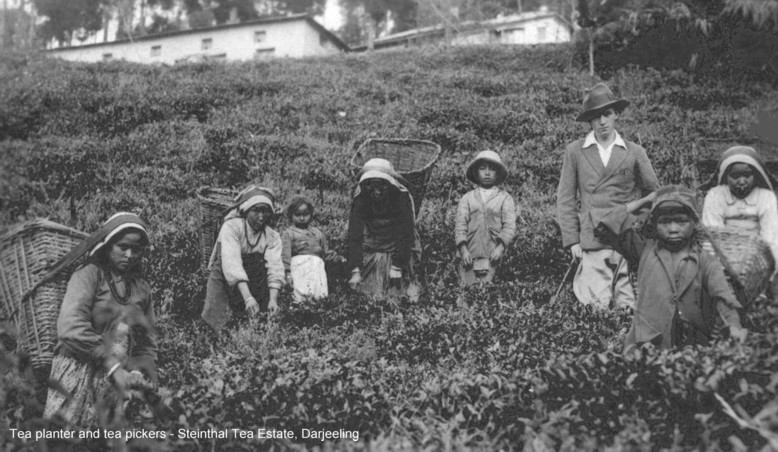
This photo is found at: http://oldmhs.com/older_darjeeling.htm and the caption reads, "Tea Planter with Tea Pickers, Steinthal Tea Estate 1930s"

Recently, I purchased a package of Darjeeling First-Flush Steinthal FTGFOP1 from TeaGschwendner. Now, readers of this blog (both of you) might know that I live very near one of the only TGs in the U.S., and that I passionately love their line of Darjeelings, which have been a source of great tea education and pleasure for me. Nevertheless, I have had some struggles with their Steinthal Estate first-flush Darjeeling.

I've tried this tea in the past, and I've never really been happy with the results. I assume the fault was with me and my preparation methods, so I am trying again. After the third pot of the tea this week, I think I've got it. Sort of.

THE BACKGROUND
The Tea Gschwendner Web site says this:
Founded in 1852, Steinthal is one of the oldest gardens in Darjeeling. Many of the original plants still thrive in a place where the tradition has been First Flush excellence. Fresh and herbaceous with subtle muscatel peeking through, the Steinthal packs a sizeable bite with the hallmark astringency that First Flush fans adore.
THE PREPARATION
6 level teaspoons for 1 liter (about 4 cups) filtered, boiling water. Strictly 2 minutes steeping time, in the lined, cast-iron Japanese tetsubin. Accompanied by McVitie's Hob Nobs. I am hoping for better results if I am extremely careful to follow Tea Gschwendner's steeping directions.

THE LEAVES
Dry, they smell very much like... well, like dry leaves crackling underfoot in Autumn. The leaves are fairly small pieces, very tight, and color ranging from olive green to dark brown. Upon steeping, they take on a very lovely maybe camphor-like aroma, with a spark that reaches the upper nasal cavity in the same way that eucalyptus has-- though, obviously, not as nose-clearing.

THE CUP
This is a transparent cup with a deep golden-brown color. The tea itself has very little scent. The first cup of the tea is very astringent, a little bit harsh, and is quite strong. There are certainly floral notes, but it's not primarily a floral tea. This is all about that bite that the TG Web site mentioned.

THE SECOND CUP
I almost always like a pot of tea's second cup better than the first, because the chemistry in the pot has had the opportunity to mature the flavor. The Steinthal's second cup (of the first steeping) is smoother, but it still isn't what I would call a smooth tea. It's a bit harsh on the back of the throat, and it has a very pronounced flavor. Now, when I say it's a bit harsh, I mean, in comparison to other first-flush Darjeelings I am familiar with. The flavor is quite bright and attention-getting, with a very nicely lingering aftertaste of sweet garden herbs.

AND YET ANOTHER CUP
This tea seems to need some time to relax and become itself, and the third cup is much more pleasant than the first. It still has a slight burn at the back of my throat, but now there are berry flavors developing-- like blackberries, or grapes, or some such rich, sharp flavor.

OVERALL IMPRESSIONS
This is a bit of a temperamental tea, in my opinion. I've tried it a number of times, and for whatever reason, it's difficult for me to coax out of it that certain special something that I look for when I drink Darjeelings. Its brightness is just a bit harsh; its aftertaste, just a bit dull; and its subtleties seem overshadowed by the"hallmark astringency" that all the kids go on about these days. While I do like my Darjeelings opinionated, this one seems somewhat overpowering for my taste. That being said, I still like the tea, and I am likely to buy it again.

Tuesday, April 21, 2009

REVIEW: 2009 First-Flush Oolong from Soureni Estate, Darjeeling, FreshDarjeelingTea.com


2009 has been a very special year for me, because after all these years of learning about tea, I finally feel as though I'm coming home. This is because of the happy combination of proximity to and attending an influential tasting by a first-class tea vendor, Tea Gschwendner; plus the friends I have made through the Facebook group "A Cup of Tea Solves Everything"; and discovering a host of tea bloggers and writers I did not know even existed a couple years ago. And now being part of TeaReviews.com, I am also given the opportunity to savor teas I would not otherwise have been in a position to enjoy.

One new friend in particular, Sonam Paljor Lama, who operates FreshDarjeelingTea.com, has sent samples to me from my beloved Darjeeling, which has been a delight and an education. I've never tasted such fresh tea from a first-flush. Being in the States, teas typically take a little longer to get to us.

THE TEA
Sonam sent me a brand-new 2009 first-flush Oolong from the tiny Soureni tea estate, which is wedged between the large Singbulli and Phuguri estates. I have high hopes, because the Phuguri Darjeelings have long been my favorite. (Though, this year, the Arya first-flush Darjeeling was so spectacular... but back to this tea!) This year the growing season was cut short because of a late start, which means the first-flush Darjeelings are more rare. Sonam writes that most of the highgrown, exotic Darjeelings are still yet to come. Yay, this should be an exciting season.

THE LEAVES
What an interesting scent awaited me as I opened the package and stuck my nose into it. It wasn't really the scent that I'd later find in the cup-- rather earthy, almost; woody. After steeping, the cup's scent differed dramatically from the spent leaves, which had a sharp spicy smell. The leaves themselves were very beautiful-- small leaves and buds, perfectly shaped, usually in the classic two-leaves-and-a-bud configuration. They were predominantly an olive-green color with a reddish hue overlaying it.

THE PREPARATION
5.5 minutes with water just below boiling, in Great-Grandma's Japanese porcelain teapot. I approximated Sonam's steeping time, which I found on his blog.


THE CUP
Beautiful peach-amber color in the transparent cup. The scent! I love the smell of a fragrant tea. This smells of cherries and honey, maybe a smell of roasted sugar, and a bit of something floral high up in the aroma. Again, why has no enterprising perfume artist created a first-flush Darjeeling-scented aroma? It would be intoxicating.

This tea is an oolong, but to me it just says, Darjeeling! The terroir seems to define the tea to me, more than does the method of its preparation. Its Darjeelingness-- that lightly fragrant and complex scent; its astringency and brightness in flavor; its long finish-- that's what I come for.

THREE STAGES OF THE CUP: HOT, WARM, COOL(ISH)
The cup seems to move through several stages as it cools slightly in the cup: Hot, it's all about the scent, which I described above. Complex, fascinating, sweet, slightly floral, amazing. As it goes to Warm, there is rather a bit of bitterness that develops. Perhaps its the long steeping time that Sonam said he used (and I would typically only steep a first-flush Darjeeling for maybe 2 to 3 minutes, rather than a full 5 to 6), but I would rather have skipped that part. On my next time around, I think I'll steep 2 minutes and perhaps employ a larger number of steepings. But then in the slightly Cool stage, the bitterness almost completely vanished, leaving this almost winelike honey flavor that is indescribable, with a dryness in the mouth and a long finish that makes me think more of savory-sweet herbs like tarragon.

TASTING THE ECHO
Hot, the second steeping is very smooth, with the sharp elbows tucked in. The scent of the cup is sweet, more restrained and relaxed. There is still the astringency in the back of the throat, with no bitterness to speak of. Same brightly golden-brown color. The flavor is more haunting and ethereal, with layered notes of cherry and honey that rise up and meet you in an almost shy way, rather than assertively sticking their hand out and pulling you in. As the tea cools, it develops the characteristic dryness in the mouthfeel.

By the third steeping, I am not noticing the tea's increasingly elusive flavor while sipping, so much as the memory of her voice echoing sweetly after she has already left the room. In the aftertaste, the flavor characteristic to this tea makes itself felt.

When reading this to Suzanne, I tell her the tea reminds me of her. She said, "Sweet and layered? Like an onion? [laugh]" I responded, "No, like a parfait!" MY WIFE tells me it is delicious, and though she feels she doesn't have a palate that can pick out subtle nuances, she loves how fresh and clean the tea feels in her mouth.

Wednesday, April 15, 2009

REVIEW: FreshDarjeeling.com, Arya Estate Darjeeling, Premium First Flush 2009

Darjeeling from the Arya Estate, Premium First Flush 2009.

I love this cup of tea. I love it. And it is sent to me by Sonam Paljor Lama, who lives in Darjeeling and operates FreshDarjeelingTea.com (opening soon) and his blog, http://blog.freshdarjeelingtea.com/ Sonam was kind enough to send me a sample, which I am really enjoying right now. Thank you, Sonam!

THE TEA
The tea comes from the Arya Estate, and is the brand-new 2009 spring tea. As a first flush, I expect the tea to be light and bright, with an airy flavor. Let's see how that expectation bears out.

THE PREPARATION
Filtered, boiling water into my cast-iron Tetsubin, over 4 teaspoons of tea, for 3 minutes. This tea can go for maybe up to 5 minutes, but I'll go with a shorter infusion for my first time.

DRY LEAVES
The dry leaves are tightly furled, ranging from forest green to a brighter spring green. When opening the package, such an unusual smell-- a smell of vegetal decomposition, almost pine. I love smelling things that seem unidentifiable but beautiful.

WET LEAVES
What a wonderful, strong scent comes from the wet leaves: like ash, like honey, tobacco-sweet. The leaves opened up into beautiful green-brown leaf fragments.

THE CUP
Beautiful amber-brown cup, transparent and clean. The flavor is bright and intense-- nothing relaxed about this tea. It seems like it's shouting, or dancing. It has a very pleasant astringent dryness that moves across the tongue, and the flavor is so caught up in the fragrance. Sonam suggested the tea is like roasted honey, and I am inclined to agree with him. But to say that seems to make it seem cloying, when it is bracing instead. What an exciting cup of tea! This is why I drink Darjeelings.

THE SECOND CUP
As I pour the second cup, I must come back to the leaves. As they've sat a few minutes, they have become more floral, with a grape arbor scent. Imagine sitting under a grape-leaf canopy in northern Italy, smelling the fragrance and taking in the scenery-- that's what this makes me think of.

The color of the cup is still the same richly brown-amber appearance, clear to the bottom of the cup.

Now that the cup has had a few minutes to cool, and as it allows the complex chemistry in the pot to deepen and add layers to the flavor, I definitely notice a honey scent that strongly makes me think of a beehive. Rather pungent and delicious. There is a roasted flavor as well. (And that sounds exactly like Sonam's description! Remind me not to read other people's reviews before I make my own.)

The flavor seems to lock in immediately, and then stay intense all the way through until the aftertaste, where it remains a sort of bright tingle at the back of the mouth and throat. Even after the second cup, I am not losing the intensity. But rather, there is a mellow smoothness developing in the cup as it cools slightly.

This is an extraordinary and intriguing cup of tea, the best I've had in quite a while. This seems like just that perfect Darjeeling-- bright, sharp, sweet, layered, and unique.

Wednesday, April 1, 2009

REVIEW: Organic First Flush, Single-Estate Darjeeling Tea, FTGOP-1, The Lavender Lounge Tea Company

http://www.lavenderloungetea.com/
1-877-LLTEACO
Lavender Lounge Tea Company
"Organic First Flush Single Estate Darjeeling Tea, FTGOP-1"

This is a tea swap tea (Thank you, Evelyn!), which is a single-serving tea bag. The tea is quite fresh, within the tinfoil, sealed bag.

PREPARATION
Boiling water, single bone china cup (covered), 3 minutes

THE LEAVES
The leaves are fairly small, quite black, tightly furled, and within some kind of clear nylon baggie thing. I'm not used to tea bags, and this nylon bag is new to me. I hope it won't affect the flavor of the tea. Also, I'm also not used to brewing single servings. Experiment, ho!

The tea is transparent to the bottom of the cup-- which is different from the Clipper tea that I drank earlier this morning. The cup is a rich peachy brown color, quite nice.

THE LEAVES
I cut open the tea bag and poured out the leaves. Very unusual aroma-- similar to the unsteeped aroma that hit me as I opened up the package. Very bright and a bit like fruit, with the sent of ash. The leaves are broken with quite a few very small pieces. I love the scent of the leaves, and I hope it carries through to the cup (which is unlikely, because teas almost never taste or smell like the leaves they leave behind).

THE TERROIR
This is the French term for "placeness," which always affects the flavor and smell of the tea. I wonder what single estate this tea comes from? I'm not enough of a tea person to be able to guess, sadly. Maybe someday I'll arrive at that point, where I can tell these kinds of things. At any rate, I wonder why some companies hide the place where they found their teas. I would think it's a selling point, and also a method of teaching their customer base about what their likes and dislikes are.

THE CUP
Very sweet and fruity. To my surprise, I am getting the same smell in the cup as in the leaves-- quite strong, too. For a first-flush, this is a bit surprising. It seems to have the complexity of a second-flush. There is definitely that grapey (muscatel) flavor all the kids go on about. Really, this is probably the dominant feature of this tea-- it almost tastes as though it were brewed with grape juice, rather than simply water. It has a very vibrant, grape-and-herb aftertaste. What herbs? Sweet, like tarragon, or basil.

OVERALL IMPRESSIONS
I can't wait to get my hands on the second cup and compare impressions maybe a few days later. It's pleasing, and I would like to find out more about it.