Showing posts with label 2008. Show all posts

Sunday, August 16, 2009

Review: Tea Hub, Da Hong Pao (lightly roasted) 2008

I recently wrote about Tea Hub's "Organic Da Hong Pao (heavily roasted)," and I urge you to read about it in full. An excerpt:

Da Hong Pao is one of China's famous oolong teas, and is one of the world's greats. It's known in English as, "Big Red Robe," named when a Chinese emperor was so overwhelmed by the tea that he gave his robes of office to an underling and commanded that they be placed at the roots of the tree that produced this great thing he was tasting. It's been cultivated primarily in the WuYi mountains forever, and the volcanic rocky soil produces the tea's very unique flavor.

As with all things, other people have already written about Da Hong Pao at great length, and I love reading information such as this, which I found at The Seven Cups:

In the last 1000 years, hundreds of varieties of tea bushes have been identified as growing in Wu Yi Shan. Out of these hundreds of bushes, Da Hong Pao, Tie Luo Han, Bai Ji Guan, Shui Jin Gui are considered the Four Famous Wu Yi Wulongs. Of the four, Da Hong Pao is unquestionably the most famous. What are considered to be the mother bushes of Da Hong Pao still live in the cliffs of Wu Yi Shan, and are now over 350 years old. Since Wu Yi shan has so many bush types, the famous teas are always produced in small quantities. They will never be truly common products, at least the tea grown inside the mountain range; there are a lot of areas in the surrounding mountains that are producing large quantities of these cultivars. Certainly the most common of the rock wulongs is Rou Gui, a cultivar that some locals rank as better than the more famous teas.

I beg you to read the rest, if you wish to learn about Da Hong Pao.


THE PREPARATION
As before, I made the tea with my patented gong-faux tea stylings, in which I use my very Western tea equipment to approximate as best I can a true gongfu preparation. Namely, lots of leaf, very short steepings. As I've explained elsewhere, tea prepared in this style can be drunk as a book is read: in chapters. Each short steep allows the various flavors to be read separately, rather than all in one as is the Western method of tea preparation. And using a lot of leaf, you have the benefit of many steeps, all with different characters. (I've never tasted a tea yet that allows 39 steeps, but I'm looking!)

1) Rinse
A quick rinse to clean off debris from the leaf, as well as to wake up the leaves properly for a nice first steeping.

2) 1st Infusion: 25s
The tea is transparent and pure, and it has a good mouthfeel. But yet, it's a bit sharp, a touch bitter. I believe this is a fault of my own gong-faux and not that of the tea's. It is ever more clear that I need a competent instructor to help me increase the finesse of what I can get out of the multiple-steeping Chinese tea preparation. In retrospect, for Da Hong Pao, I would start with a quite short steeping-- perhaps 5 seconds-- and then go up from there. This is a tea with strong bones, and it must be respected (even though it is lightly, not heavily roasted).

3) 2nd infusion: 15s
Much more to my liking. Tea is clear, beautifully amber-peach-brown in color. The fragrance is lovely and light, and has a unique minerality that I've come to expect from Da Hong Pao. It is noticeably less "roasty" in tone than the last Da Hong Pao I tasted from Tea Hub.

4) 3rd infusion: 20s
Gorgeous aroma, which makes me think of sculpting clay or slip, perhaps-- a bit mineral, and beautifully rich. It's not a floral aroma, by any means, but it's sweet and sharp at the same time. The aroma seems to carry the flavor at first, but as it cools, the bright, sharp flavors rise up in the mouth, as well. The oolong has a pleasing mouthfeel, just a bit tingly, but with a great presence. This is the best steeping yet, and well worth the price of admission.

(4th, 5th, 6th infusions: No notes taken, so sorry.)


OVERALL IMPRESSIONS
I really do love this tea. It's got bones, it's pure, it's complex, it is nuanced, and the flavor is utterly distinct. The light roasting allows me to taste the tea itself, rather than primarily the roastiness, which I think is a good choice.

Well done, Tea Hub, on sourcing this tea. Thanks!


[And by the way, I'm quite proud of finding the image above, which is a perfect counterpoint to the heavily roasted Da Hong Pao from TeaHub, which I interviewed previously.

>> UPDATE: I corrected the link above, so the picture of the young monks sends you to the right Web site. I hope you'll visit there, because it's a great site.]

Friday, July 24, 2009

REVIEW: TeaHub Organic Spring WuYi Da Hong Pao (heavily roasted), 2008

TeaHub Organic Spring WuYi Da Hong Pao (heavily roasted), 2008

Created in my patented gong-faux style. Please do not try at home. Trust me.

ABOUT DA HONG PAO
Da Hong Pao is one of China's famous oolong teas, and is one of the world's greats. It's known in English as, "Big Red Robe," named when a Chinese emperor was so overwhelmed by the tea that he gave his robes of office to an underling and commanded that they be placed at the roots of the tree that produced this great thing he was tasting. It's been cultivated primarily in the WuYi mountains forever, and the volcanic rocky soil produces the tea's very unique flavor.

For the reader who is not as familiar with Chinese tea preparation, the gong-fu style of tea involves a large amount of tea leaf and a series of short steeps, rather than one long steep, as is common in British-style tea. When I drink Chinese tea, I have not been trained in Chinese gong-fu preparation, so it's obvious that my tea will not get the best results you would find with seasoned tea masters. Nevertheless, I try to be as careful as I can, paying close attention to the water, the pot, and such things as I an pick up by reading masters on the Internet. Thus, I am pretty certain I can make a pretty decent, if not mind-blowing, cup of tea.

Gong-fu tea is like reading a poem broken into multiple stanzas, or a book with a number of chapters, or a play in several acts. Or a multicourse French meal. Or some other metaphor divided into smaller, baby-sized submetaphors.

TeaHub's Organic Spring WuYi Da Hong Pao (heavily roasted), 2008, is a good example of how this can work to provide an interesting tea experience. You don't drink the tea to get a huge whallop of caffeine and go on with your day. Instead, you slow down just a bit and read the progression of the tea as it transforms slowly across the "Acts."


A TEA FLIGHT IN FOUR ACTS

Introduction: 25-second infusion
In the play's introduction, you get to know a little bit about the characters, and what type of story this is. Is this a drama? Comedy? Are the characters strong, weak, conflicted?

Strong, roasty flavor is predominant, with a high note of sweet honey and something sharp but difficult to define, sort of a buzz, up among the clouds. Suzanne, my wife, says, "It had a weight to it, without being bitter or heavy." Very pleasing, full mouthfeel, which coats the mouth and throat.

Act 1: 20s
Now we get into the story itself. A plot arises. The conflict emerges.

I taste a bright, hard edge, with very complex roasty base. Mm, second infusion better than first. A bit of charcoal, slight drying in the mouth.

Act 2: 20s
By the second act, we would get to the sexy love scene and maybe a murder or two.

The tea is much sweeter now. Still, there's this tingling buzz in the mouth, which is likely my response to the particular combination of astringency and sweetness in this cup, which has an unusually complex manifestation. The drying compliments the richly smooth mouthfeel.

Act 3: 30s
Ah, to the meat of the play. The conflict naturally moves toward its climax.

Roasty, sharp, excellent, best yet. Beautiful, exciting flavor that is complex without being overbearing, light but strong.

Act 4: 40s
And the finale, the conclusion, the dessert course.

Flavor profile receding, probably could steep longer. More mineral taste developing.

Exeunt: 50s
At this point, the main action is over, and it's all about getting the bill, the after-dinner mint, and hitting the streets.

Now the tea is weak enough that the mouthfeel has subsided almost entirely, and we've entered the realm of new decisions. How long do I want to drink this tea, as its flavor slowly fades into a whisper? For this tea, it would be difficult to push this terribly far, but interesting enough, perhaps, to try it. I'll probably keep steeping this into the afternoon, just to see what happens and how far it can go, but it won't have the same punch as those early infusions.

UPDATE: Now includes link to to TeaHub Web site, above.

Monday, July 6, 2009

Comfort Food: Phuguri Estate Darjeeling


In my parents' house, comfort food was (and remains) all-American fare like tomato soup and grilled cheese sandwiches, or stuffed peppers, or Swedish meatballs-- in spite of the fact that none of us are Swedish. When I asked about that, Dad once told me they were made out of ground Swedes. As opposed to air Swedes, I suppose, which are far too difficult to catch. [Ba-dum-dum! Thank you. I'll be here all week.]

Last night's educational but unsatisfying tea-tasting adventure left me wanting something familiar, so this morning as I work, I have returned to my beloved 2008 Phuguri Estate 2nd-Flush Darjeeling FTGFOP1, which I bought from TeaGschwendner not long ago. To my shock, I discover I have not written a review of this tea yet! Rather quickly, because this is a workday, I will try to let you see what I love about this particular Darjeeling.

It's a funny thing, how tastes change over time. Lately, I've been very interested in exploring Chinese green teas and some dan cong oolongs, which I am less familiar with. But the Phuguri provides me the comfort of coming home again. Indeed, this is my go-to tea whenever I am in need, and when I can afford it. It's middlingly expensive, but I can go through it so quickly that it easily blows through my tea budget.

This tea is extraordinary. It's a second-flush Darjeeling, with all the complex notes that attract and keep my attention from the moment I smell the leaves, all the way through to the amazingly complex and long-lasting huigan [sweet aftertaste].

Phuguri Darjeeling is a black tea that appears to be darkly transparent amber. The power of the tea is locked in its flavor, not so much the aroma. The flavor reminds me of Spring honeysuckle, with both smoothness and not-quite-tart astringency at the same time.

The second-flush Phuguri estate Darjeeling never fails to make a completely satisfying cup. Delightful, subtle yet bold, dry yet smooth, with a restrained sweetness I find entirely captivating. It's one of those teas that I drink with my eyes closed, and which I need to return to over and over again. If TeaGschwendner ever stops selling it, I'll have to move to India.

Sunday, July 5, 2009

Review: Simpson & Vail, Kenya Oolong 2008


Simpson & Vail. I rather like the cut of their jib. They are a fairly mainstream tea company who make the interesting choice to offer oolongs from unusual-- i.e., not Chinese-- sources, such as Vietnam, or in this case, Kenya.

Kenya is one of the biggest sources of tea worldwide. Most of the tea I see from them is commoditized-- it is sold to be blended into grocery-store brands, and the teas are not typically single-estate self-drinkers, intended to be unique vintages. Usually, the black teas from kenya are fairly robust. So when I see a Kenya Oolong, to be distributed by Simpson & Vail, I am intrigued. What in the world is this going to taste like?

THE TEA
Simpson & Vail has this to say on their Web site:

This delightful offering from Kenya features a new taste sensation in the world of Oolongs! The tippy, brown-black, medium sized leaves brew to a golden cup with an earthy aroma and a fresh, bold, slightly citral flavor. Brew tea at 195º - steep for 4-5 minutes
.
THE PREPARATION
I tried two methods of preparation: First, I did a gong-fu preparation (really, gong-faux, because I don't have all the gaiwans and Yixing pots one would ordinarily use). Then I followed the directions on the Web site. You will see below my results.

THE LEAF
This tea's leaf appears to be like a very typical, medium- to high-end black tea: smallish leaves, most certainly CTC (cut-tear-curl machine processed). The tea factory employed a machine to process the leaves, and they created a highly oxidized, nearly black, leaf.

THE GONG-FAUX FLIGHT

1 10s, rinse

2 25s
This cup seems most like a malty black tea, and is quite unlike the Chinese and Taiwanese oolongs I've been tasting of late. It's fairly ascerbic, and seems to want a bit of milk and sugar to cut it. The tea is a bit on the acidic side for my stomach, which is complaining. Interestingly, there is quite a bit of tea oil floating on the darkish-brown liquor, making it quite shiny. There is a faint hint of oolong-ness, though. I'll keep up with the next steeping and see where this goes. So far, honestly, I am not really liking this very much, as it tastes quite like a typically harsh, grocery-store black tea to me.

3 20s
The second steeping, shows me the leaf a bit better, as it reconstitutes. The leaf appears now to be maybe 60% oxidized: green at the centers of some of the larger leaves, but the overall visual impression tends more to the reddish-brown. The leaves have a pretty nice aroma of

The liquor maintains the deep brown (but transparent) quality of the first steeping. There is just not much flavor here (maybe this means I should have steeped for the full 4 minutes, rather than trying gong-fu method for this tea). The tea is just... flat. The bitterness has abated somewhat on the second steeping, but the flavor has not picked up where it left off.

4 20s
The flavor remains as it has for the previous steepings, and doesn't seem to be abating at all. Still like a black tea that is not particularly inspired. I quit, because I am not liking these results at all and want to abandon this preparation style.


. . .


AS AN EXPERIMENT, and a bit dispirited by the failure of my multiple-steeping method, I am now drinking the tea per the Web site instructions. It is better than the gong-fu style. There is a woodiness about it that is pretty appealing (at least, compared to the tea flight I was just attempting). A little sweetness to the aftertaste, and I detect a bit of nuttiness. ("Oh, I'm detecting nuttiness, all right," says the rat from Ratatouille, whose voice lives in my head.)


OVERALL IMPRESSIONS
Meh. This is not the tea for me, because though it is supposed to be an oolong, it seems more like an average "black tea," which you might find in a grocery store anywhere. I've tried to enjoy it by employing a couple of different preparation methods, but I just can't.

Friday, July 3, 2009

Review: Simpson & Vail, Vietnam Imperial Oolong, 2008


Nope, not those Simpsons.


Simpson & Vail have been around awhile-- since 1904-- and have remained a small, family-oriented business all the while, as is evidenced by the History section of their Web site. While the history discussed their tea grinder, which they used to use to break down whole-leaf teas into particles usable in a teabag, bagged tea is now only a part of their overall catalog, with loose-leaf teas of various types available.

Vietnam Imperial Oolong is their most expensive, selling at $6.05/oz. at this time. Unfortunately, other than the generic nation name (we know the tea comes from Vietnam), the Web site is little help. I don't know precisely where the tea comes from, or what time of the year (or even what year, though I guess it is 2008) it was plucked; nor do I know details about how heavily it is fermented. The Web site says this, though:


Vietnam Imperial Oolong T0766
The tightly curled, deep olive-green leaves of this superior oolong unravel to produce a pale green cup with a refreshing sweet and smooth taste. The tea has outstanding notes of honey with a slight spice aftertaste. Brew: 4 minutes at 180°F.


PREPARATION
In my inimitable gong-faux tea stylings, I will use a fairly large amount of leaf in a lidded cup, around boiling, but for short steeps. Please, please, do not try this at home, using such an unsightly hodgepodge of tea equipment. I won't even show you a picture, such is my shame.


THE LEAVES
This is a very lightly oxidized leaf, rolled into balls. Lightly fragrant before steeping, but quite aromatic once the hot water hits. It smells much like a green tea, with high hints of maybe orchid, or

10s
Rinse and discard

Steeping 1: 25s
The tea is quite aromatic, and smells much like a nice green tea. The cup is a light green color, and the aroma is floral, roasted honey and green, without much vegetal quality. A sweet huigan [aftertaste] lingers, which mixes nicely with the clover scent coming from outside my window.

Steeping 2: 20s
The tea is still pale, transparent green, but not terribly strong. This tea does not knock me down and take my lunch money, if you know what I mean. There is now a slightly bitter quality to accompany an increasingly dry mouthfeel. There's a lemony, citrus taste haunting the huigan, which is mild but lingering and pleasant.

Steeping 3: 20s
Not an aggressive tea, though very slightly bitter. Very like a green tea. As the leaves open up more and more, I find the leaves show very little sign of oxidization-- no reddish at the edges of the very complete leaf sets of two leaves-- furthering my impression of this as a very lightly oxidized oolong. As the tea cools in the cup, the bitterness seems to dissipate, leaving a green, grassy flavor and aroma I most often associate with Chinese green teas. The roasted honey notes remain strongly in the nose.

Steeping 4: 20s
Much the same as Steeping 3. Light and refreshing, very much like a green tea. Aftertaste less noticeable, but I drank it with dinner. Gregory, my seven-year-old boy, squaffed his down quite quickly, once the temperature got down to where he could drink it.

Steeping 5: 30s
The leaves are quite full now, having absorbed about all the liquid they're going to absorb. I did see one leaf with a bit of red at the edge. Again, the exception proves the rule: this is a particularly lightly oxidized oolong. The flavor is much more elusive at this point, as is the fragrance. Pleasurable mouthfeel, with just a hint of green at the back of the throat.

OVERALL IMPRESSIONS
I always wonder if people ever read to the bottom of the post. Anyway, pleasant enough, light oolong, which tastes much like a simple, not-too-flashy green.

Friday, May 29, 2009

REVIEW: Fang Tea, Medium LiSan Oolong

PORTRAIT OF THE TEA ENTHUSIAST AS A YOUNG MAN

When I was a little boy, perhaps 10 years old, my sister Kate (the flautist formerly known as Kathy) and I went to Ponderosa Steakhouse, which we walked a number of blocks to get to. It was a big deal, and we had to cross the Big Street to get there. Ponderosa was a buffet-style steak restaurant, not at all fancy. I remember they had vanilla pudding with whipped cream on top, which I thought was the bomb. Anyway, I clearly remember the two of us sidling up to the buffet ordering line, and I noticed something I'd never seen nor heard of before: Teriyaki Chicken.

This is the first Culinary Moment I can recall. My taste buds exploded as I experienced a flavor palate I was absolutely unfamiliar with. I can remember even now the raw amazement I felt as this foreign-tasting, gloriously new thing was introduced to me. This was a turning point for me, one that changed forever the way I view food.

From that point on, whenever we'd go to a restaurant, I'd make sure to order something I'd never heard of before. I didn't like to read too carefully the menu descriptions, because I didn't like to spoil the surprise. Sashimi! Pho! Cambodian lime chicken soup! Bratwurst! Veal canneloni! Chicken croquettes Pozharski! Borscht! Beef carpaccio! Blue cheese! The only thing that keeps me from eating out every meal is my pocketbook. One of the great delights in my life that moment when I am introduced to an entirely new taste that my palette has never imagined.

And this brings me to tea. ("Finally!") One of the glories of the last year of my life is that I've been having this experience again, and again, and again. This makes me a somewhat uneven reviewer, because I'm approaching these teas with an open heart but not often enough experience to apply a jaded standard, "Well, this is a pleasant enough [insert tea here], but I really liked last year's much better."

And so I approach Fang Gourmet Tea's "Medium LiSan Oolong" in this spirit. Having tasted it the first time, my taste buds opened up to an entirely new profile of flavor I've never thought of before. This is so unlike other teas I'm familiar with, I'm absolutely delighted to have something new to indulge in. I am having the best time, right now, as I sip and type. Something amazing and new! LiSan Oolong!

THE TEA
Last week, Fang Tea in New York was kind enough to send me a package of this tea. I knew it was going to be special, so I waited until I had the right moment to unwrap the package. Fang's packaging was quite smart, with the tea leaves protected in a vacuum-packed foil packet, which was inside the tin. The leaves appear to have a medium level of oxidation (hint: the word, medium, in the tea's name), which implies a certain level of body and complexity.

To research this subcategory of oolong tea, I read the blog by Winnie, who is with Teance, a high-end San Francisco tea shop. Winnie's blog, Tea Adventures, gave me the following:

Li Shan means Pear Mountain, and in the past, the most sought after fruits, particularly pears, came from there. Today, such famous heights as Da Yu Ling, and Fu Shou Shan, has dwarfed the fruits and made tea the most profitable and sought-after crop from this region. Li Shan oolongs generally refer to elevations of 1700-2000 meters,... The mountains are impossibly dangerous, downright scary in its steepness. One look at the prospects of tumbling down the hill from harvesting makes one understand all the fuss.

She goes on to write:

Li Shan Oolongs are the most intensely fragrant, smooth buttery oolong there is, topping Taiwan oolongs growing everywhere else. Particularly, there is a pronounced taste of gan that lingers for an entire day, with less and less astringency the higher the elevation, no matter how strong a cup of tea you make. Incredibly sweet with a taste of fruit that's been cooked at high heat, Li Shan tea no doubt is so highly sought after, many unscrupulous merchants would try to dupe the unsuspecting consumer. It is highly unlikely to buy any Li shan tea less than $200 USD p/lb. at a retail level, and at that price, one is guaranteed that it came from the second-flush or 'second spring', or lower elevations at 1700 meters. Da Yu Ling oolongs are well over $300 p/lb., and difficult to acquire even if one would pay for it, for all of the crops are usually spoken for.
Okay, check. Great tea, often at least partially faked up by opportunists. Now, in a lovely note in my Fang Tea package, Kyle Shen, the proprietor of Fang Tea, wrote:
Pear Mountain, or LiSan, is located in a highland climate region with an altitude of more than 2,000 meters. Tea quality from this region is especially superior, and LiSan Oolong has the highest index among the Taiwan high mountain oolong tea.

I hope you'll enjoy this tea as much as I do.
So I'm primed for this tea to be a pretty special experience. While I typically focus on the Darjeeling and other Himalayan teas, I have slowly been coming to truly love these Chinese-style teas. From Fang Tea's Web site, I find much the same information provided in the letter. Fang doesn't detail the name of the tea master, or tea farm, from which they get the tea. Would it pass the Teance test of authenticity? I can't be certain, but at this point, I would certainly guess that it does.

So I opened up the Hao De blog, which gives a very detailed description of a good way to steep Oolongs. I do want to derive the greatest pleasure I can from this experience-- I would hate to mess it up because of my own lack of knowledge-- so I follow his directions to the letter. The results are delightful, amazing.

THE LEAVES
The largish brown-and-greenish leaves are in big, complicated wads. When the package was cut open, there was such an unusual scent-- fruity, earthy.

MY GONG-FAUX PREPARATION
I haven't yet purchased a proper gaiwan and associated hardware, nor have I been trained in their use by a Chinese tea master. But I try to approximate the process I read about by using porcelain covered cups and careful attention to temperature and timing. Following Hao De's advice, I filled a cup 1/4 full of the balled oolong leaves. I did a number of short steeps, and I slowly increased the length of the steepings until the tea stopped being pleasurable. The notes below, I took as I tasted. I'll leave them as is, only editing the most egregious errors.

steeping 1: 30s
not very flavorful tea liquor yet
the scent of the leaves is outstanding, so unusual

Because the tea hadn't taken on the flavor yet, but the leaves were so brightly scented, I held up my steeping cup near my nose while I drank, sort of borrowing the aroma to flavor the tea. Very harmonious, though probably not something I'd do when people are watching. I couldn't keep my nose out of the steeping cup, away from that aroma.

steeping 2: 20s
totally unique flavor. now the tea begins to taste like the scent of those leaves.

steeping 3: 20s
Noticeably stronger flavor!
what is this aroma/flavor combination?! almost a mint/pine brightness, slightly dry in the mouth, like rich fruit and and perhaps a bit floral, but like no flower I'm familiar with.
just a hint of bitterness now developing
bright, amazing savor

steeping 4: 20s
best steeping yet. glorious. my wife and I are sharing the tea between us, and i am having a hard time believing how good this is. or keeping up with her demand for tea.

steeping 5: 35s
flavor maintaining its profile very nicely

steeping 6: 45s
(same)
I am enjoying just sipping, not writing. This is definitely a tea to be savored, and probably writing this post is taking away from that. The next time I make this, I will write nothing and taste everything.

steeping 7: 60s + 5m
60s is not enough, the taste is too weak. I will now follow another tea master's advice and start using longer steeping times. Don't be horrified! I poured the water back on the leaves and steeped this time for 5 minutes. drinking alone now, and wanted to get the most out of the tea.
at 6m, the tea tastes great again, though the mouthfeel is getting much weaker.

steeping 8: 15m
Just too weak to be enjoyed anymore. Faint hint of flavor, but not enough to compel me to fill up on more liquid.

As I walk around after the tasting, the complex, lingering aftertaste follows me around the house, clearly and distinctly, and much longer than I expected.

OVERALL IMPRESSIONS
Awesome tea, and one of the best experiences I've had yet with oolongs. I am very anxious to get back to this tea and just drink-- no typing-- with my eyes closed and some music playing. Thank you, Kyle at Fang Tea, for the gift of such excellent LiSan Oolong. I'm a convert, and I will obviously have to search out more of the tea from Pear Mountain.

Wednesday, May 27, 2009

REVIEW: Mighty Leaf, Emerald Pearls


Emerald Pearls, by Mighty Leaf

One of the perils of writing reviews is that you sometimes stumble upon other people's reviews of the same product. In this case, I've recently watched the enjoyable Walker Tea Review, with Jason Walker, who said this is what he would consider a "base model tea," to paraphrase; or in other words, that tea with other green teas would be compared. "It's more floral," or "It's more vegetal," that kind of thing. Well, let's see what I think, for what it's worth.

THE LEAVES
Emerald Pearls are certainly an emerald green, but not in "pearl" shape-- or, rounded balls of tea leaf. Instead, the leaves are short spears, deeply green-black in hue. I asked the Mighty Leaf person on Twitter about the name, and got a reply that perhaps the name signified its value and rarity. When steeped, the leaves unfurled in a forest green, with hints of gold. There is definitely a warm, garden scent to it-- the vegetal, or asparagus, note that Jason Walker speaks of.

THE CUP
My wife took a cup and wandered off into the other room with the baby. She said, "Wow, what is this? Mm, this is good." Or words to that effect. She liked it! Hey, Mikey!

Golden-green, transparent to the bottom of the cup. The tea has a rather dry mouthfeel, and it is nicely fragrant. It's a rainy day today, and as I stood in front of the open door with the tea flavor fresh on my tongue, I thought of my Grandma's wonderful garden, and how it smelled on a rainy day. I realized that the tea itself was providing the fragrance that triggered the memory. There's a slight sweetness, and the slight dryness doesn't really detract from the smoothness of the cup. I like that astringency, and it goes well with the hint of citrus in the high notes, or the umami of the low notes. The low note hangs on in the mouth, with a very long and pleasant finish.

Umami, for those of you unfamiliar with the term, is the elusive "fifth flavor," which accompanies the usual sweet, sour, bitter, and salty. It is caused by L-glutamate (and other variations of the glutamate molecule), which is present in large amounts in green tea. It's a yummy meatiness, or a satisfying happy flavor that is difficult to pin down, but wonderful to experience. If you want to learn more about umami, go to this Web site: http://www.npr.org/templates/story/story.php?storyId=15819485 .

OVERALL IMPRESSIONS
I find this tea to be very satisfying and pleasurable in a simple, unobtrusive way. Nothing in this tea screams for your attention, but instead, it feels welcoming and homey.

Tea can be purchased here: http://www.mightyleaf.com/chinese-tea/organic-emerald-pearls-green-tea/

Monday, May 25, 2009

REVIEW: Zhi Tea, Royal Gold


Zhi Tea
2008 Royal Gold


There's a sharp spiciness that is quite elusive, which I've come to think of as that Yunnan taste. It's highly unusual and distinctive. In a way, it reminds me of the aroma of a beehive: pollen-sweet, but with a sharp buzz.

I've moved away from drinking Yunnan teas of late, because I had been drinking them so much in years past. I typically tasted a mid-grade bulk Yunnan, which was sort of the benchmark flavor I came to associate with the region's tea. Coming back to it is rather exciting, because it's like visiting a friend I haven't seen in a while.

For those who have never had a Yunnan: It appears as a black tea, though the Chinese would categorize it as a red. It is full-bodied and has an intensely spicy flavor and a distinct aroma that I find a bit hard to describe, but it's what I always think of as that "Yunnan scent." And the flavor has a very unique flavor profile, as well: spicy, sharp, slightly bitter, slightly sweet, dry, smooth. It's the contrasts in the cup that are so beguiling. The Yunnan red teas are often described as earthy, sometimes smoky, malty (a description of mouthfeel, mostly), floral, honeyed. A fellow named "anodyne" on the ChaDao blog did a fairly extensive survey of Yunnans over a number of blog posts, and these were instructive to me as I began to think about this tea today.

THE LEAVES
These are lovely gold-and-black leaves, tightly twisted (which prevents such quick oxidation of the leaves, allowing them to taste better longer). Upon steeping, a very distinctly spicy aroma comes up from the chocolate-brown leaves, which have unfurled into beautifully long needle shapes. The leaves are quite complete, but no sign of insect bites, which is usually a sign of pesticide-free production.

THE PROCESS
1 tsp tea leaves to 1 cup near-boiling water, in lined Japanese cast-iron tetsubin.

THE CUP

THE FIRST STEEPING
This tea is sharp and spicy, just a bit bitter. My wife likes its smoothness and the cleanness of the flavor. On the other hand, I find it just a bit dry, and the bitterness, I find, slightly off-putting. The liquor is opaque, and I can't see the bottom of the teacup. There's a sharp spiciness that is quite elusive, which I've come to think of as that Yunnan taste. It's highly unusual and distinctive. In a way, it reminds me of a beehive: pollen-sweet, but with a sharp buzz (if you will) that is quite arresting. And there's a honey flavor within that, which seems as though created by some exotic bee somewhere. That being said, that bitterness was just a bit too much for me. On the second cup of the first steeping, I cheated and put in some sugar to ameliorate it. My wife, on the other hand, loved it and was disappointed that we had run out of tea so quickly.

THE SECOND STEEPING
Much of the powerful mouthfeel has gone out of this Yunnan Royal Gold by the time of the second steeping. The liquor is now a transparent brown, clear to the bottom of the cup. A bright earthiness becomes apparent, almost a metallic taste, though in a pleasant way. The bitterness is gone, as well. I definitely recommend taking this tea to at least a second steeping, because there are nuances that are revealed once the more powerful flavors are given their moment in the spotlight, and now can release the stage to the other actors. There's a slight woodiness, as well, which seems unusual with the more watery mouthfeel of the cup.

OVERALL IMPRESSIONS
I really do like this Yunnan, and it's a good reintroduction into this type of Chinese red tea. Strong, bold, interesting flavors to match the spicy, exotic aroma. Thank you, Zhi Tea, for such a great offering.

>> UPDATE: ADDED WEB SITE ADDRESS FOR PURCHASE: http://www.zhitea.com/store/detail.aspx?category=14&section=13&id=539

Friday, May 22, 2009

REVIEW: Zhi Tea, Snow Mountain Green

The most beautiful place I have ever seen is the Königssee, in the Bavarian Alps, which I quite desperately long to visit again. It was summer, and my wonderful friends brought my wife and me to the high mountains surrounding the crystal lake, where the blue flowers against the verdant valleys echoed the perfectly clear sky framed by high peaks. These remain strongly in my mind, and the memory is sweet, though growing a bit fainter over the course of years.

The reason I'm thinking about this is because Zhi Tea's Snow Mountain Green tea is also like an exercise in memory. When drunk according to Zhi instructions, the tea taste is mostly experienced in its aftertaste, where the long finish unfurls the various aromas.


THE LEAVES
Surprisingly curly, twisted silver-white leaves with a very lightly floral fragrance. As they are steeped, they take on a jade-green color, long leaf tips joined together with a tiny bit of stem. Carefully crafted. The leaf aroma after steeping is not completely attractive, but it's interesting: a memory of the

THE TEA
Snow Mountain Green is a China green tea from the Hunan province.

THE PREPARATION
1 teaspoons of leaf in 80C reverse-osmosis filtered water, 2.5 minutes steeping time.

THE CUP

Two days ago, when I prepared this tea, I followed the Zhi tea instructions: 1 tsp per cup. As I made it, I thought the end result would be rather weak, because the large leaves were not very dense in the cup. I was right. Such a pale green-gold, the liquor was as transparent as clear water. The flavor of the tea itself was rather elusive, with a lovely aftertaste 2-3 min after sipping... like cherry, slightly bitter, dry, and rather flowery.

And so today I made the tea again, this time with double the amount of leaf per cup. The tea is lovely. The liquor is a just slightly foggy gold, with almost a cherry blossom aroma. As the leaves cooled, I noticed a green grape aroma coming from them in the pot. The tea was much more nuanced, with faint fruit-- grape, perhaps-- and with a floral aroma high up in the profile. Very springlike and fresh, smooth, with a longish finish.

Truly a beautiful tea, which benefits (to my taste) by being steeped with double the leaves as the Zhi packaging and Web site recommend.


(Beautiful picture of the Konigsee is able to be seen on an Alpine photography tour run by John Baker.)

Thursday, May 21, 2009

Review: You, Me and Tea, Quangzhou Milk Oolong


The flavor of this Milk Oolong from Quangzhou is quite singular, and though I've used up my sample, I'm already wanting more.
With this review, I hope to pique your interest so you might explore a rare tea that will surprise and intrigue you. I will be reviewing a pretty rare type of oolong from Quongzhou in China, the elusive creature known as the Milk Oolong.

You, Me and Tea gives rather little information about this tea on their Web site. Here's what they write:
Quongzhou Milk. Luxurious, that's what you can call this tea. It has a most unique character best described as sweet milk. It has impeccable orchid notes.
Okay, not much to go on, but sounds delicious. Note to the writers for You, Me and Tea: Because the tea has such an interesting backstory, you may want to write up more complete and interesting descriptions.

BACKGROUND
As I searched about online, I discovered that two of my favorite reviewers, Cinnabar at GongfuGirl, and Troy at TeaViews, have already written eloquently about this tea. I'll quote Troy here, who did some research into what this tea is all about.

Milk Oolong, according to the common story, is the product of leaves harvested during special seasonal temperature drops. These temperature drops, one would assume, infuse the leaves with a thicker milkier sap that curdles slightly during normal Oolong processing. I have, however, heard that the flavor is actually achieved by the addition of milk during the steaming of the leaves. I put a bug in David's ear, a voracious all consuming bug, when I asked him if he could find out whether this was the case, or not. What he found was at first a chorus saying that their products were Au-natural, followed by admissions that most of the producers do add milk to “enhance” the flavor. Clear as mud, eh?
Searching my memory, I do remember something about this. This is typically a limited-edition tea, because Milk Oolong can only be produced when there is a sudden drop in temperature, just at the time of the harvest. Very little of this tea can be created each year, because the conditions that give rise to this are quite rare.

THE TERROIR
Where is this tea from? Quongzhou (Guangzhou) is part of the Wuyi mountains, and has a very ancient tea culture. I'll quote from a local tourism Web site for the region.

Lingnan's tea culture is one of the four main tea cultures in China.

Lingnan Area consists of provinces of Guangdong, Fujian and Taiwan and the Guangxi Zhuang Autonomous Region with Guangdong as its core area.

Lingnan people began planting tea in the Tang Dynasty (AD 618-907). A man called Cao Song brought some seeds of tea from northern China to Guangdong and planted them in Xiqiao Mountain. Since then, Lingnan's tea culture has become an important part of life here.

Because of the hot and humid climate, tea is a must-have daily drink for Lingnan people.

In the Ming Dynasty (1368-1644), Lingnan people started a special Cantonese-style breakfast Yam Cha, or Dim Sum, which is popular little snack steamed, deep-fried or boiled.
Tea and dim sum? I'm sold. The site goes on to say that the practice of gongfu tea brewing also began in this region. Brilliant!


THE PREPARATION
Filtered water, rolling boil, 2 minutes maximum, porcelain teapot.

THE LEAVES
Dry, the leaves appear green-to-black, in little wads and a fair amount of broken leaf dust in the pouch. It does have a very unusual scent, very rich and thick. I could definitely imagine this scent being associated with sweetened, condensed milk, rather than the typical green or sharp smell one gets from the teas I've been driking. It has a silky nose to it, if that makes any sense at all. In fact, if I hadn't been told that this was a tea that I was smelling, I may not have figured it out without looking. As many good oolongs do, the tea opens up into full, deep green leaves. There are high floral notes I can discern in the tea leaves, which help me pick up that aroma in the tea itself.

THE CUP
This tea is a pure, pale-gold tea that is clear to the bottom of the cup. The tea perfectly carries the aroma from the leaves-- rich, creamy, with the faintest bit of flower very high up in the aroma, set against the heavy thickness of the lower aroma.

For this tea, the aroma and the flavor are indivisible: like springtime irises and slightly carmelized sweet cream. One could see this flavor infused into a complicated dessert by Gale Gand. I enjoyed the tea the most when it was fairly piping hot, and liked it progressively less as it cooled in the cup.

THE SECOND, THIRD, AND FOURTH INFUSIONS
For this tea, I performed multiple steepings, and each was fully as enjoyable as the first, with even more complexity of flavor, with a faint dryness in the mouthfeel appearing for the first time, and the caramel aroma heightening.

This tea's giving just goes on, and on, and on. Third infusion, the mouthfeel is not quite as silky as before, but the taste and aroma are still bright, with that milky and floral flavor very pronounced.

OVERALL IMPRESSIONS
I do wonder about whether this tea was soaked in some kind of milk, or if they achieved this effect completely naturally. The flavor of this Milk Oolong from Quangzhou is quite singular, and though I've used up my sample, I'm already wanting more.

(Picture by Conservation Journal Online.)

Monday, May 18, 2009

Review: Zhi Tea, Royal Gold


Reviewing: Zhi Tea Royal Gold

Zhi Tea's Royal gold is familiar, it's friendly, and it's got complexity and intensity enough to make me happy while not needing to be explained to people who don't drink tea every day.

My life has changed a lot since I started writing about teas. For starters, I now have a healthy and happy baby girl of three months. And because I work at home, my tea times have become much more often packaged between bouts of work and diapers and carrying Charis in the football hold that leaves me entirely unable to type, but very able to read with the occasional mouse click. I've had the pleasure of reading many other tea bloggers, who write passionately and enjoyably about this obsession of mine. I find that some of the best tea bloggers, aside from their obvious breadth of knowledge and charming insight, also seem relaxed, and they are not trying to impress the reader. Humility seems to go with the territory, and I will try to emulate that here.

THE TERROIR
Yunnan is the heart of tea, and where it seems to have originated. The Web site reads:

Our organic Royal Gold from Yunnan Province is the queen of China Black tea! This top-most grade is comprised entirely of gold-tipped new-growth spring buds that produce a gorgeous dark gold liquor infusion. After harvesting, the buds are painstakingly hand-sorted, resulting in an exceptionally high-grade tea. When oxidized, these gorgeous buds turn gold rather than black and when steeped, release a rich, smooth flavor with lingering notes of honey, roasted almond, and bing cherry. The flavor will evolve through subsequent infusions (yes!). A royal treat.
I would like to know more from the Zhi Web site: Where in Yunnan is this tea created? What is it like there? How does the terroir affect the flavor of this specific tea? How is this specific vintage distinct from other Yunnan teas out there?

THE TEA
Zhi Tea offers their Royal Gold, which is a Yunnan black tea. The dry tea is made up lovely twists of brown-and-gold tippy leaves, which give off a tiny bit of yellow tea powder from the travel. The leaves are nice and crunchy when I crumble them in my fingers, which means this batch has been kept safe from its archenemy, moisture. Bodes well for a good pot of tea. The tea leaves have a rather dusty smell, like chocolate powder, perhaps. The scent makes me think the subsequent brew will be malty and thick... ah, but not so fast!

THE PREPARATION
Using Great-Grandma's Japanese porcelain teapot, my lovely wife prepared 3 cups barely boiling water with 3 generous tsps of the tea. Generous, because the tea leaves are pretty large and are therefore not too dense in the teaspoon. We steeped the tea for about 3.5 minutes before pouring off.

THE SPENT LEAVES
This is a very fragrant tea. The leaves have a rather spicy, dark, heavy scent, and they unfurl to large, chocolate-brown leaves that remain furled fairly tightly.

THE CUP
...And the cup belies the scent almost entirely. I was expecting heavy, thick, mouthfeel. Some people like this, but I don't particularly. However: I found the tea's flavor and aroma to be very clean and bright, with pungent berry notes and the kind of mouthfeel I would typically expect in perhaps a green or first-flush Darjeeling-- not at all heavy or malty. There is a very bright berry flavor (the Web site suggests bing cherries, and I am certainly willing to accept that), and the finish is quite subtle but lasting. One point of contention: The tea is not at all golden in color, but rather a dark brown, not truly transparent to the bottom of the cup. I did follow the instructions of the Web site, so I am not sure how their in-house preparation differed from mine so much that they arrived at such a result.

THE SECOND CUP
Interestingly, as the tea cools, the flavor dulls considerably. The higher, intense berry notes are gone; and the body note, the heavier chocolate-spice, has gone missing. For my taste, this tea seems to have a very quick life in the cup, and it benefits from being drunk quite hot, just as it leaves the pot. The second cup did not fare very well, and seemed much less interesting than the first cup. This is in opposition to many teas I have enjoyed, particularly from Darjeeling, in which that second cup is where the real business is.

The Half-Dipper Web site includes a nice discussion of the way aromas in tea behave, in this post. Here is a short excerpt from a thoughtful blog post, "Tasting Tea."

When you pour the soup out of the wenxiangbei [aroma cup], you get what perfumers (and modern day biochemists) traditionally term the "top note" or "head note". It's all of the "light" volatile compounds that make it into the nose first - you get lighter, higher notes such as sweetness, floral compounds, etc. Teafolk might call this the beidixiang (BAY DEE SHEE-ANG), lit. cup-bottom scent. Do you get mushrooms? Flowers? Sweetness? If so, what sort of sweetness?

As these disappear, and the "heavier" volatile compounds take over, you get the "bass note" or "body note". Perfumers liken their craft to music, and it's easy to see why. As an engineer, I think in terms of low-frequency spectral content and high-frequency spectral content - it's exactly the same as the audio analogy. (Engineers are great to take to concerti - "oh, listen to the high-frequency components in that section!") This heavier stage consists of deep sugars, richness, lowness, bass notes, that kind of thing. Teafolk might call this the lengxiang (LUNG SHEE-ANG), lit. cool-scent. Molasses? Brown sugar? What do you get at this point?

Sensing of these compounds gives you an indication of the content in various stages of the tea. Often, the aroma correlates with observations made using the mouth, throat, and aftertaste. It can another way to determine what compounds are tucked away inside your tea.
Do please read the article to enrich your own enjoyment of really tasting your tea.

OVERALL THOUGHTS
At any rate, this is the type of tea that benefits from paying it close attention, because it has a lot to offer. Some of the teas I most enjoy seem made for very private enjoyment, but this one is something I would easily see serving at a gathering of friends who don't usually drink tea (like most of my friends), but enjoy having their palates expanded. Zhi Tea's Royal gold is familiar, it's friendly, and it's got complexity and intensity enough to make me happy while not needing to be explained to people who don't drink tea every day.

Saturday, May 16, 2009

REVIEW: Mighty Leaf, Organic Yellow Flower


Mighty Leaf offers a green tea they call, Organic Yellow Flower.

I love that moment when I open up a package and get to smell a new tea. Upon tearing it open today, the Yellow Flower tea lit up the room with this bright fragrance, very floral. The leaves are very fragrant, and I am very excited about this tea. This is pure green tea, with no additives, but it still smells very floral and fragrant. I am definitely looking forward to tasting this.

80C, 1 tsp Per cup, 2 min

This tea should probably should be 2 tsp per cup, because it's a bit too weak following Mighty Leaf's posted instructions to use 1 tsp per cup. But still very delicious, if faint.
Liquor is almost clear, palest yellow. But a very heady aroma, nevertheless: floral, bright, beautiful. The aroma rather reminds me of Green Hill Tea's version of Dragonwell-- quite intense with a nicely long finish. The flavor of this tea seems best when the cup is warm (rather than piping hot), and the lower-range aromas appear.

The company's Web site tells us,

Organic Yellow Flower green tea, is a handcrafted tea grown in China's Anhui province. Often called yellow bud or yellow flower, its slender green-yellow leaves yield a sweet, floral character and a yellow colored cup. With a clean and smooth taste this chinese tea will refresh and revitalize.

Anhui is a great tea-growing region of the world, and it shouldn't surprise us to find lovely teas coming from here.

UPDATE
The above was edited, thanks to an alert reader who let me know that Anhui and Anxi are, in fact, not the same thing. I was a victim of transliteration!

Wednesday, May 13, 2009

REVIEW: Narien Teas, Dragon Well


To say a cup of Longjing tea smells "grassy" is like saying a steak tastes "meaty." While true, it doesn't really convey much information.

I'm drinking the Dragonwell (Longjing) by Narien Teas today. Dragon Well is one of the ancient tribute teas, which were given to the Chinese emperors and were only to be drunk by his court. I'm exploring Longjing teas for the first time, and it's been very enjoyable.

Narien provided enough tea for me to try a few methods of preparation. The most interesting is:

For single cup brewing, fill a cup with about a tablespoon of Dragonwell tea leaves, then add steaming water. You want the water almost boiling in order to almost cook the tea leaves and infuse them into the water. After the leaves steep in the water for several minutes, you will notice some of the leaves will start to become turgid and sink to the bottom. This is when the tea is ready.

Traditionally, the leaves are not strained out, as they would continue to brew while you drink. Dragonwell can be enjoyed with a dash of sugar or even a bit of honey, but often the natural sweetness of the tea can be enjoyed without. The leaves generally can only be brewed once because the hot water cooks them, but you can squeeze multiple cups if the leaves do not steep too long and are brewed again within about an hour. The flavor will be a little sharper, similar to black tea, but a little sugar makes it taste just as sweet.

Well, I did try it this way, and the results were good, though I didn't quite know what to do with all the tea leaves floating at the top of the cup, which kept trying to get into my mouth. I'm sure the Chinese have thought up a very clever way of solving this conundrum. At any rate, it was fun to play with my tea leaves in a new way.


I also did create the tea in a teapot, 1tsp per cup. This made a more restrained cup of tea than did the method of leaving the leaves in the cup and drinking around them. I liked better the results from the more unusual preparation, though I wish I had figured out a good filtering mechanism to keep those leaves under control.

The tea itself: Transparent rich amber-gold color, rather deep in saturation, like the walls in a Tuscan villa. This tea is nicely aromatic, like grass! No, wait. Very slightly vegetal, and not really too floral. There's a slightly sweet honey to it, especially when it's quite hot.


(Dragon sculpture can be purchased at 1001Homes.co.uk.)

Saturday, May 9, 2009

2009 Spring Longjing tea, Green Hill Tea


2009 Spring Longjing tea (Dragonwell), GreenHillTea.com

http://stores.ebay.com/Green-Hill-Tea

I'm a pretty enthusiastic tea drinker, because it affords me so many opportunities to indulge in surprising flavors and aromas. Recently a friend of mine, George from GreenHillTea.com, sent me a sample of his Dragonwell-style tea, and I loved it.

Now, because this is a moderately priced longjing that does not originate in West Lake (although it does come from the correct region, Zhejiang Province, China), I feel a need to curb my enthusiasm. But I don't want to. I like it!

For years, I have focused almost entirely on Darjeeling and other Himalayan highgrown teas, which have been my passion and great pleasure. But in the last year, I've finally been delving into the Chinese greens and oolongs. And me being me, I feel a need to learn everything I can about the new types of teas I'm drinking.


THE HISTORY
Throughout the centuries, China's emperors demanded tribute teas from the various regions. This is the origin of the Chinese 10 Famous Teas. The list is somewhat changeable, but everyone agrees that Longjing (or Lung Ching, or Long Jing, or other interpretations as the Chinese is transliterated into English) is at the top of the list. Happily, the world is now allowed to drink what used to be the privilege of emperors and their favored friends.

Longjing literally means "Dragon Well" tea, which is because all the dragons who live in wells really like this tea. Or something. Anyway, a fanciful name for an unusual tea. The leaves look quite unusual: they are flattened spears, with a slightly shiny appearance. This is because each Longjing-style tea needs to be processed by professionals who use the 10 Steps, or 10 hand motions that must be precisely followed to shape the tea like this.

I think the reason a lot of people like to drink green teas scented with other things (ginger, or flowers, or fruits), is because they haven't ever tasted a green like this, which naturally has so much complexity that to put something in it would be absurd.

This tea is the 2009 Spring Flush Longjing, which means it was only picked a couple weeks ago, and it's perfectly fresh. They're still right in the middle of the Spring harvest season, which is finishing up shortly, I think, and they're working around the clock to produce these teas. To get an idea of what goes into making the great green teas of China, please read this article: http://the-leaf.org/Issue1/wp-content/uploads/2007/12/chinas-legendary-spring-green-teas.pdf

I am thinking about how the best first-flush Darjeelings seem to bend toward how this green tea is tasting: brilliant, complex, bright, and wonderfully fragrant. I've never noticed how a black and a green tea could be so similar, but it's like that sweet spot where Mozart and Beethoven seem to reach toward one another.

Now, Longjing is traditionally sourced from a single place, Zhejiang Province, and from the West Lake. (However, there are many 'longjing'-style teas, which are made in 14 different provinces throughout China. But it's important to try to find a tea that comes from the right province, in the same way you would want your champagne to be from Champagne.)

There are about 30 different subvarieties of Zhejiang Province longjing, and this one comes from JiuFen Mountain, in JinHua. George tells me it's quite an ordinary longjing-- fairly moderately priced, around $90 per pound-- and it's not the very high-end tea from the region that can run easily over $200 per pound.

Because I don't have a wide variety of experience with longjing to weigh this tea against, I can only enjoy it on its own, freshly and without preconceptions.

Note to self: Definitely go search out different grades and styles of Zhejiang longjing!


THE PREPARATION
Water brought to boil then cooled to 80C, steeped 3 minutes in Great-Grandma's porcelain Japanese teapot.

THE LEAVES
Ridiculously Fragrant.

The aroma that met me when I opened the packet of 2009 Spring Longjing from GreenHillTeas.com was knock-your-socks-off intense, an exquisite citrus-and-ocean-green scent that I just cannot believe hasn't been turned into a perfume by some French parfumeur.

THE CUP
The liquor is a pale yellow, perfectly transparent liquid. The flavor is same as fragrance-- pine, citrus, ocean, sweet, and delightful.

OVERALL IMPRESSIONS
Well, because I can't compare this against other longjings, I can only say that my family and I truly enjoyed the experience. It's very pleasant, every once in a while, to find a moderately priced tea that one can derive great pleasure from. In the words of MarshalN, of A Tea Addict's Journal:

Remember -- good tea is rarely cheap, but cheap tea can be good, and most importantly, expensive teas are not guaranteed to be good at all.

Monday, May 4, 2009

REVIEW: Red Leaf Tea, Peony White, 2008


Red Leaf Tea, Peony White

It's late evening, and the family has gone to bed. Time for something to drink. I'm grateful to Red Leaf Tea for their generous gift of tea, which I'll sample tonight.


The Red Leaf Web site reads:


Description:

Hot on the heels of our hugely popular White Tea blends comes this offering that is made of an even higher grade of tea. Peony White Tea is made only from the finest tea buds and leaves plucked in early spring from Fujian province in China. These ingredients are steamed and dried soon after picking, ensuring that all of the health giving properties contained therein is intact.

Brewing Instructions For A Single Cup:

Amount Of Water 6.0 oz
Amount Of Tea 1 tsp.
Water Temperature 170°F
Steeping Time 5-7 minutes

As always, I wish that Red Leaf had published the background of the tea, including details of where and when it was produced, a bit of history about this tea itself, and so on. I have not tried any of the Red Leaf brand flavored white tea mixes, so I can't compare with their other "hugely popular" whites.


THE TEA

Peony White is a white, unprocessed tea that is called bai mu dan in Chinese, and it is one grade lower than silver needle, bai hao yinzhen. I'm initially attracted to this type of tea, because it's unflavored and simple, and should afford some nicely complex flavor and aroma to wake up my tongue and nose tonight.

High-grade white teas are to be steeped for a fairly long time, which allows the layers of flavors to develop. I'm going to steep this at 170 for the entire 7 minutes, to get the full measure that the tea will provide.


MY MEDITATION TONIGHT

While I wait for my tea, I'll meditate a bit on the nature of my changing tastes. When I first started drinking tea, about 20 years ago, I was like most Americans first encountering teas of a higher grade than teabag fannings: I enjoyed the flavored teas with lots of additives. Over time, I settled into a very happy place, drinking high-end, single-estate Darjeelings and other highgrown Himalayan teas, without any additional flavors, trying to refine my own palate. And this year, I am finally delving into the Chinese teas, as well. I'm finding that the highest-end Darjeelings and the Chinese greens tend to reach toward one another, meeting in this zone of clarity in the cup, and brilliance of flavor, and nuanced subtleness that carries me through many stages of flavor and aroma in a cup, and in a pot.


THE PREPARATION

1.5 cups boiling water, brought down to 70C, with 2 heaping teaspoons of tea, in Great-Grandma's porcelain Japanese pot. One of these days, I'll perhaps start investing in Yixing, but at the moment, this is producing a pretty nicely consistent product.


THE LEAVES

Dry, they are silvery-gray buds with a very floral aroma in the high register, without a lot of deep or darker scent.


THE CUP

This tea has a very deep, port-wine golden color to the liquor, while still retaining its transparency. The tea has a very, very light scent, which is barely noticeable, but which is definitely floral in character. This is a very subtle, very smooth tea.


I don't know why, but this tea sets my mind thinking in terms of sound: This tea, were it transliterated into music, would be Samuel Barber's Adagio for Strings, Op. 11., perhaps; or piano music by Ginastera. In fact, I've put this music on in the background while I drink, a Pandora Web radio station that works nicely in the U.S.: http://www.pandora.com/?sc=sh30802010806901952 .


The tea, like the music, is polished and does not have sharp edges to jar me as I drink and listen. In some ways, this is a bit too subtle, a bit too restrained for my taste, yet still lovely. The bai mu dan has notes of honey, of cherry fruit, of green grass-- but one has to go looking for it, searching the subtleties out carefully to capture the quiet sensations. The tea coats the mouth with an almost buttery sensation, without any hint of dryness.


OVERALL IMPRESSIONS

This tea carries very lovely flavors, but in such a muted way (almost to the point of dullness) that I stretch to really discern what is going on here. I drink this in Spring 2009, and this is the Spring 2008 vintage. It is perhaps because the tea has been sitting a complete year before drinking that accounts for the overly restrained character of this cup. I'd like to try this Peony White again with a very fresh Spring plucking to see how they compare.


(Photo can be found on this lovely travel blog post, ComeFollowUs.com: Wandering Through Wuyishan)

Thursday, April 30, 2009

REVIEW: The Tea Spot, Vintage Oolong


http://theteaspot.com/vintage-oolong-tea.html

THE TEA

The Web site reads:
Our Vintage Oolong is a pure Taiwanese, single–estate, medium–bodied oolong. With a sweet, nutty flavor, this tea captures the subtlety of what amazing, full–leaf tea should taste like. Hints of ripe apricots and lilacs combine to produce a tender, timeless green oolong; hence the name! This tea yields a bright, amber liquor and should be re–steeped multiple times. Each successive steeping will unveil new flavors & aromas, until the leaves are fully opened. Delicate, refined, and understated - this is the true connoisseur’s tea!
My only complaint is that the Tea Spot people didn't let us know on their Web site which vintage this tea is, nor which field is comes from, nor what time of year it was picked. For my personal education in tea, I long for this information.

THE PREPARATION
Because this is a green oolong, and it's fairly dense (the leaves are small crumpled balls, rather than long twists), I will use 1 tsp with 1 cup filtered water, boiled and allowed to cool to 90C, for 2 minutes, in Great-Grandma's Japanese porcelain teapot. Well, that was the plan. In practice, a sudden interruption meant that I actually ended up steeping for 3 minutes, which is a bit long for a green oolong, in my opinion. Let's see how it worked out.

THE LEAVES
These leaves when dry are highly fragrant, green smelling, with nutty and floral notes. The very tightly bunched, little balls opened up upon steeping into beautiful, large leaves of a very rich, summery-dark grass green. They have a buttery, rich scent, almost like buttered popcorn or rich cooked greens.

THE CUP
This tea has a terrifically golden cup, transparent and very shiny. Drunk very hot, the flavor is a bit difficult to discern-- slightly woody, with a mineral tone. As the tea cools, the flavors start to show up on the scene: a floral flavor, sweet like lavender, perhaps, but quite subtle, with green grass and hay. There is a dry, grassy or woody mouthfeel, which nicely counterpoints the sweetness of the aroma. The flora aroma and flavor continue to develop as the cup cools, creating a very complex experience for me.

THE SECOND CUP
As I say every time, I always love to try the second cup in the first infusion, because time and heat have allowed the tea to oxidize further and develop its flavors more fully. For this tea, the second cup is definitely drier than it was before, and the flavor is fully-formed, with great floral, grass, and wood notes. This tea has distinctly green characteristics-- grass, hay, dryness-- with a fruitiness as of maybe apricot or peach, which is that semi-oxidized oolong character.

OVERALL IMPRESSIONS
Even though I don't know where the tea is from, it's still quite lovely, and the fragrance is really quite something.

Wednesday, April 29, 2009

REVIEW: Tea Gschwendner Formosa Fancy Taifu Oolong


Photo from the lovely Web site, taipics.com.

TeaGschwendner Formosa Fancy Taifu Oolong, 2008

This offering by TeaGschwendner is the winner of the 2008 Best Dark Oolong, from the 2008 World Tea Championship.

The Fancy Superior grade is bestowed only upon exquisite, tippy teas such as the Taifu. Known as “Five Color Tea,” northern Taiwanese Oolongs are oxidized around roughly 60% and take on various hues of brown—from beige to sienna. The Taifu is a heady cup, a nuanced sketch of wood and stewed plum. Infuse multiple times.

THE LEAVES
The dry leaves in hot pot: smells like roasted honey, like sweet black currant jam (and I'm proud of myself for figuring out what that elusive smell was-- but it's currants, on the nose!). The leaves are large, black, tightly twisted, with bits of dark-reddish tippiness showing up. After steeping, I can see why they call this "five-color tea," because the leaves take on many hues of reddish- to greenish-brown, with large open leaves. As the leaves cooled in the pot, they took on a mineral and muscatel aroma, a very complex scent that was rather heady. I love the smell of good wet tea leaves!

THE PREPARATION
2 heaping teaspoons per cup @ 2 cups boiling water, in Great-Grandma's Japanese porcelain pot. (It makes me happy to use this pot that had been sitting fallow all these years.)

THE CUP
This is a nearly transparent but quite dark brown tea, and highly fragrant and strong. The aroma, though, is very weak to the tea liquor itself. There is a hint of bitterness on the tongue and a complex, almost medicinally herbal flavor, with a very smooth and creamy mouthfeel. To me, the most enjoyable aspect of the tea is in the long aftertaste, which keeps shifting on my tongue. It goes from herbal, to cream, to chocolate, to dark honey, to something sharp and ascerbic....

SECOND CUP
For this tea, the second cup was much the same to me as the first, without a great deal of new flavor development. I'll be interested to find how multiple infusions play out. Drinking alone, I think I'll have to just taste the infusions and just allow some tea to go cool, because otherwise I'll be floating. Seems like a waste!

MULTIPLE INFUSIONS
  • The second infusion: 4 minutes, boiling water. The cup is still a deep brown, with a hint of fogginess, perhaps, as I peer to the bottom of my cup. When drunk very hot, the tea has a distinctly metallic characteristic, as though it was steeped in spring water with a high mineral content, instead of simply filtered water. The flavor is somewhat subdued, and a bit earthy, though perhaps not as smooth as the first steeping-- a bit ascerbic, a dry mouthfeel. Although the directions say that I can do multiple steepings, the second is really not so amazing that I feel compelled to try a third. As the tea cools, the flavors declare themselves (again, primarily in the aftertaste)-- a bit like honey in the throat, some greenness up in the high register, some ascerbic dryness in the middle.

OVERALL IMPRESSIONS
This tea has won the Best Dark Oolong award for 2008. This means that this tea has been judged one of the world's great teas. It pains me to say so, but I don't love it. The reason I don't like to say so is because doing so obviously displays the limitations of my palate or my execution, rather than any weaknesses inherent in the tea. Nevertheless, I was expecting a much more complex tea, and one that would really please my senses. Though the first steeping was quite a powerful experience, I didn't thrill with pleasure as I felt I ought to do.

Monday, April 27, 2009

REVIEW: TeaGschwendner, Darjeeling FTGFOP1 Steinthal First Flush


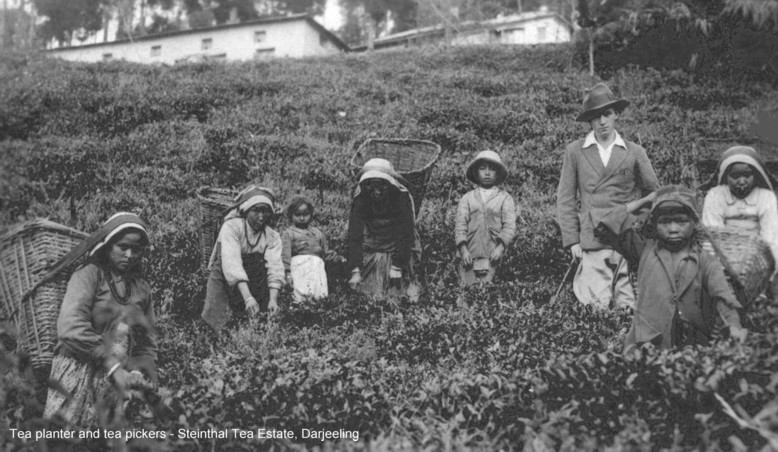
This photo is found at: http://oldmhs.com/older_darjeeling.htm and the caption reads, "Tea Planter with Tea Pickers, Steinthal Tea Estate 1930s"

Recently, I purchased a package of Darjeeling First-Flush Steinthal FTGFOP1 from TeaGschwendner. Now, readers of this blog (both of you) might know that I live very near one of the only TGs in the U.S., and that I passionately love their line of Darjeelings, which have been a source of great tea education and pleasure for me. Nevertheless, I have had some struggles with their Steinthal Estate first-flush Darjeeling.

I've tried this tea in the past, and I've never really been happy with the results. I assume the fault was with me and my preparation methods, so I am trying again. After the third pot of the tea this week, I think I've got it. Sort of.

THE BACKGROUND
The Tea Gschwendner Web site says this:
Founded in 1852, Steinthal is one of the oldest gardens in Darjeeling. Many of the original plants still thrive in a place where the tradition has been First Flush excellence. Fresh and herbaceous with subtle muscatel peeking through, the Steinthal packs a sizeable bite with the hallmark astringency that First Flush fans adore.
THE PREPARATION
6 level teaspoons for 1 liter (about 4 cups) filtered, boiling water. Strictly 2 minutes steeping time, in the lined, cast-iron Japanese tetsubin. Accompanied by McVitie's Hob Nobs. I am hoping for better results if I am extremely careful to follow Tea Gschwendner's steeping directions.

THE LEAVES
Dry, they smell very much like... well, like dry leaves crackling underfoot in Autumn. The leaves are fairly small pieces, very tight, and color ranging from olive green to dark brown. Upon steeping, they take on a very lovely maybe camphor-like aroma, with a spark that reaches the upper nasal cavity in the same way that eucalyptus has-- though, obviously, not as nose-clearing.

THE CUP
This is a transparent cup with a deep golden-brown color. The tea itself has very little scent. The first cup of the tea is very astringent, a little bit harsh, and is quite strong. There are certainly floral notes, but it's not primarily a floral tea. This is all about that bite that the TG Web site mentioned.

THE SECOND CUP
I almost always like a pot of tea's second cup better than the first, because the chemistry in the pot has had the opportunity to mature the flavor. The Steinthal's second cup (of the first steeping) is smoother, but it still isn't what I would call a smooth tea. It's a bit harsh on the back of the throat, and it has a very pronounced flavor. Now, when I say it's a bit harsh, I mean, in comparison to other first-flush Darjeelings I am familiar with. The flavor is quite bright and attention-getting, with a very nicely lingering aftertaste of sweet garden herbs.

AND YET ANOTHER CUP
This tea seems to need some time to relax and become itself, and the third cup is much more pleasant than the first. It still has a slight burn at the back of my throat, but now there are berry flavors developing-- like blackberries, or grapes, or some such rich, sharp flavor.

OVERALL IMPRESSIONS
This is a bit of a temperamental tea, in my opinion. I've tried it a number of times, and for whatever reason, it's difficult for me to coax out of it that certain special something that I look for when I drink Darjeelings. Its brightness is just a bit harsh; its aftertaste, just a bit dull; and its subtleties seem overshadowed by the"hallmark astringency" that all the kids go on about these days. While I do like my Darjeelings opinionated, this one seems somewhat overpowering for my taste. That being said, I still like the tea, and I am likely to buy it again.

Sunday, April 26, 2009

REVIEW: Teas Etc. Bai Mu Dan Loose Leaf Organic White Tea


Whenever I try out a new tea, I want to know as much as I can find out about it-- well, as much as I can find out in the time it takes to prepare and drink it. I found something at Wikipedia (which, as everyone knows, is sure to be complete). Please notice the description of how this tea is harvested and processed-- very exacting and specific:

The processing rules require this tea only be picked between March 15 and April 10. It is not picked on days that may be raining or if the dew has not dried or if there is frost on the ground. No purple buds are allowed and the stems must not be too long or too short. Partially open leaves or leaves damaged by wind, handling, or insects are rejected and put into a lower grade. The best Bai Mu Dan is produced using the two leaves and a bud proportion and is naturally or mechanically withered to produce leaves that are not black or red but green in color. And only pink or purple fairies are allowed to pick the tea leaves, but never on moonlit nights when Oberon is causing mischief. [Okay, I may have added that last bit. --Ed.]
White teas, as many people know, are as near to an unprocessed tea as one can get. The teas are steamed very early, keeping the teas from oxidizing into its darker cousins. Bai Mu Dan is often called White Peony, or even (and more enticingly) White Hairy Monkey tea.

Bai Mu Dan is described this way on the Teas Etc. Web site:

USDA Certified Organic Bai Mu Dan is truly a treat for the palate with subtle notes of sweet cream butter and light, pleasing vegetal notes.

Grown on the misty mountains of Fujian province in China, the downy silver buds and fresh young leaves are soft and intoxicatingly fragrant. The resulting liquor is a beautiful golden yellow with a more robust texture than your average white tea. The taste is deliciously rich, sweet cream butter with light, pleasing vegetal notes. Slightly astringent, it leaves behind just enough of the smooth sweetness to make you anxious for more. Over ice, this bold white tea plays coy, leaving behind the vegetal notes for an exquisitely refreshing taste experience.

PREPARATION
The Teas Etc. Web site goes on to suggest steeping at 80C for 3-6 minutes. Okay, I'll settle on 4.5 minutes, to split the difference, and I will use Great-Grandma's Japanese porcelain pot. The leaves are pretty large, so 2 teaspoons per cup.

THE LEAVES
These leaves very in color from silvery-gray, to deep forest green, to crisp Spring green. It's mainly buds with tiny, white hairs on it, but I also see broken dark-green leaves and some stem in the leaves. They have a nice crunchy stiffness to them-- no sogginess or moisture. (What? You don't take a nibble of the raw leaves every now on then?) The uncooked leaves smell of hay and grass, with a little bit of floweriness. The spent leaves, when hot, do not have much aroma at all, except for a slightly mineral scent.

THE CUP

My wife shouted from the other room: "It's good. Light, smooth, not repulsive." (laughs) Really, I should ask her permission before putting her comments here, or risk her propensity to sarcasm when she knows I'm going to quote her.

The liquor, or soup, is a beautifully transparent cup that has a lovely amber-pink-peach color. I find the flavor to be a bit elusive for my taste. I understand that the Bai Mu Dan (or Pai Mu Tan) teas are loved by many because the taste is supposed to be more robust than some other varieties of White teas. However, for me, it's a stretch because the flavor is like a voice speaking quietly from the next room: very soft and muted, and a little hard to understand.

The cup, as my wife said, is quite smooth, with a slight dryness to the mouthfeel and a very faint burn at the back of my throat. I think it's a stretch to call this, "intoxicatingly fragrant," as it says on the Teas Etc. Web site, though it's pleasant enough.

OVERALL IMPRESSIONS
This is a very restrained cup of tea that must be paid close attention to for me to notice it at all. I'm not sure if it's because this is the 2008 spring tea, and it has lost its "oomph" in the entire year since it was plucked, or because it requires different methods of preparation.

I have enough leaves to try this tea a number of times, and I will experiment with longer steeping times to draw out that "more robust flavor" that is supposed to be the characteristic that defines this bai mu dan, and separates it from other classes of white teas. I shall update when I do, to see if I can draw out more from this tea, which such exacting care and attention to painstaking details were employed to produce.

Thank you, Teas Etc., for an opportunity to taste your tea.

UPDATE:
I tried the tea again tonight. Same parameters, except I steeped the tea just over 6 minutes this time. Now I begin to understand this tea. It's still smooth in the mouthfeel, which I didn't expect; but now it has a bite that catches my attention. (Ah! A smooth bite. Makes perfect sense.) The Bai Mu Dan remains delicate, but at the greater steeping length, the flavor is more defined.

Wednesday, April 22, 2009

REVIEW: Red Leaf Tea, Golden Nepal


Red Leaf Tea, Golden Nepal

THE TERROIR
Nepal is a country in the Himalayas, and its conditions are similar to that of the high Darjeeling lands. Elevations are 4000 to 5000 feet, generally, which cause its highgrown teas to have the intensity you'd see in the Darjeelings. In fact, there are tea farms in Nepal that create teas every bit as good as their Darjeeling counterparts. Nepali tea farms are usually small and family-owned, so there is quite a bit of variety to be found. And because the Nepal brand is not as well known as Darjeeling, it means the prices can be quite reasonable for somewhat similar teas. Let's see what we have here!

THE TEA

...

UPDATE: The nice folks at Red Leaf Tea have corrected their site after I pointed out that they had the wrong description. I deleted the incorrect information from this review, and now will use the new information to complete the review. Thank you, Red Leaf, for being so quickly responsive. Here is the description I find on the Red Leaf Web site:

Similar to Darjeeling tea, this high grown tea originates from the Antu Valley in Nepal. This tea features a pronounced flowery overtone and bright, yet mild flavor. This tea is best when served plain, so that you can enjoy the more subtle flavor qualities of this premium tea.

Sri Antu is in the Ilam District, which in turn is in the Eastern Region of Nepal. Ilam is directly opposite Darjeeling-- in fact, if you are on the tea garden in Ilam, you can see Darjeeling on the other side of the valley. Virtual Tourist describes it thus:

Ilam is the far eastern district of the country, inhabited by people of different colors living in peace and harmony. Neighboring the famous Indian hill town of Darjeeling, it is situated on the foothills of Mount Kanchanjunga, The third highest peak in the world. Ilam is adorned with an almost limitless range of lush-green tea gardens. The rolling hills covered with tea leaves are simply majestic. The thick white fogs alternatively descend to veil the gardens and then suddenly vanish. Greenery prevails all over the hills of Ilam all around the year. Ilam Tea Garden located near Ilam Bazaar and Kanyam Tea Garden located halfway between Terai plain and Ilam Bazaar are the major gardens of Nepal.

THE PREPARATION
2 generous teaspoons with 2 cups just boiled water, cooled to perhaps 210F, in Great-Grandmother's ceramic Japanese teapot. Just over 3 minutes steeping time.

THE LEAVES
The leaves look pretty typical for what you'd see with a cut-tear-curl Darjeeling: small, black leaves, with maybe a hint of golden tippiness. When I smell the dry leaves, I get a very pleasant fruity scent. After steeping, the leaves had a rather dry smell, not as fragrant as I would have expected.

THE CUP
This tea seems has a transparent orange-brown cup, moderately fragrant with nice fruit scent. When I taste the Red Leaf Tea's Golden Nepal, the cherry-like fruitiness reminds me of the only other Nepali tea I have ever drunk, which came from the Jun Chiyabari estate, and is sold by Tea Gschwendner. Not to get into a contest between these two teas, but the flavor profile of this tea is rather similar, though quite a bit more restrained than the Tea Gschwendner offering. I didn't know what to expect from this tea, but it hadn't occurred to me that the regional characteristics of Nepali teas would have such distinct flavor markers that I could pick them out this easily.

The tea has a nice, full mouthfeel, with that pleasing sour cherry, woody flavor and an unusual bite at the back of the throat. I am noticing a floral scent that starts to make itself known as the cup cools slightly.

THE SECOND CUP
As I repeat every time I write (in case this is the first review someone has read), I believe my understanding of a tea is enhanced by drinking a second cup from the first steeping of a pot of tea (after the leaves have been removed), so the magic of chemistry allows the flavor compounds in the teas to react to one another in the heat of the pot, creating new flavors that were not present at the first.

Very nice. The Golden Nepal is quite smooth by the time I get to the second cup of this tea. Naturally sweet without a dry mouthfeel at all; a very well-modulated, light cup of tea that I like quite a bit. To quote an old Buddy Guy song: "...Where the water tastes like cherry wine." The tea is sweet, nicely spiked with something like a sour-cherry flavor. Nice finish, though not dramatic.

AND A SECOND STEEPING, AS WELL
The second steeping is noticeably weaker than the first. Drunk hot, the tea has very little flavor or scent at all. Upon being allowed to move from Hot to Warm, the tea's flavors reassert themselves somewhat, though in more muted fashion than before. At this point, it feels a bit dryer and more ascerbic, a bit less smooth, and not so flavorful.
The second steeping is not terrible, but really not where the heart of this tea can be found.

OVERALL IMPRESSIONS
A lovely tea for those who like Darjeelings and want to try something in the same vein, with a slightly different flavor profile. While not as ecstatic a drinking experience as the Jun Chiyabari was for me, nevertheless I enjoyed this quite a bit, and I'm glad I had the opportunity to taste it. Thank you, Red Leaf Tea, for sharing your tea with us.